


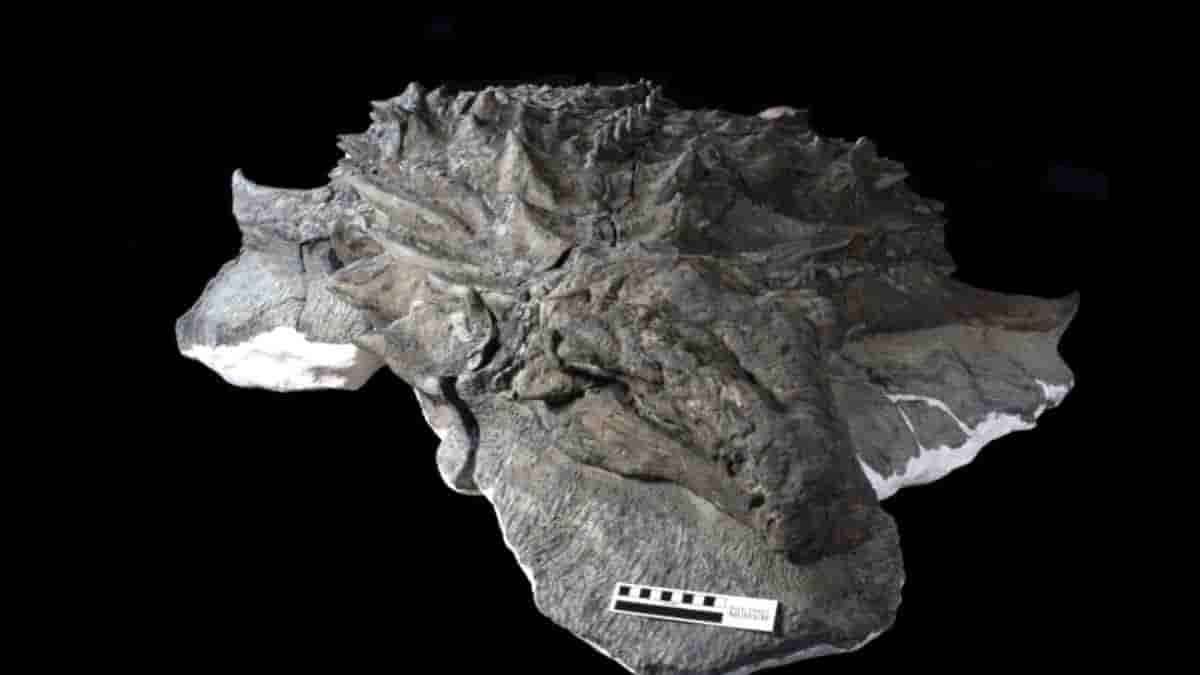
In 2011, Archaeologists were able to find the fossil of a dinosaur in the most pristine condition ever. The fossil discovered is a nearly whole fossil of an Ankylosaur and is being termed a “one in a billion find”.
Here’s more about it.
Borealopelta markmitchelli
A near whole fossil of an Ankylosaur was discovered in 2011 which was preserved in the seabed. The fossil is in its pristine condition making it one of the most remarkable specimens ever found. Dr. Donald Henderson, a curator at the Royal Tyrrell Museum has also termed the discovery as a “one in a billion find”.
It took about 7,000 hours for Mark Mitchel who is a technician at the Royal Tyrell Museum in order to dig out the fossil without causing any damage to it. His hard work nearly spans about six long years and for this effort taken by him, the new species of the dinosaur discovered is also being named after him – Borealopelta markmitchelli.
The Borealopelta markmitchelli is a species of Nodosaur which is a type of Ankylosaur that has a straight tail instead of a tail club usually seen in an Ankylosaur.
Researchers started studying the fossil after Mark Mitchel completed preparing the specimen in 2017. The studies have also helped in understanding more about the Cretaceous period in which the dinosaur lived.
The bone structure of the dinosaur was a part of one of the studies and it revealed that the bones of the newly discovered specimen were all in their natural places.
Caleb Brown, a curator at the Royal Tyrell Museum and the person who examined the bone structure of the dinosaur mentioned that the spikes on the dinosaur weren’t there to attack its predators, but were intended to attract its mates.
The study further also revealed that the Borealopelta markmitchelli used a kind of camouflage called “countershading” which shows how difficult it might have been during the Cretaceous period.
The recent study on the dinosaur is looking more at the diet of the dinosaur with more and more such studies still taking place.
Almost the entirety of this dinosaur—the skin, the armor that coats its skin, most of its body and feet, even its face—survived fossilization, amounting to what's been called a one-in-a-billion find: https://t.co/2plvVTcCqa
[📸: Royal Tyrrell Museum of Palaeontology] pic.twitter.com/hSTXn5dLnE
— Ars Technica (@arstechnica) January 25, 2023