

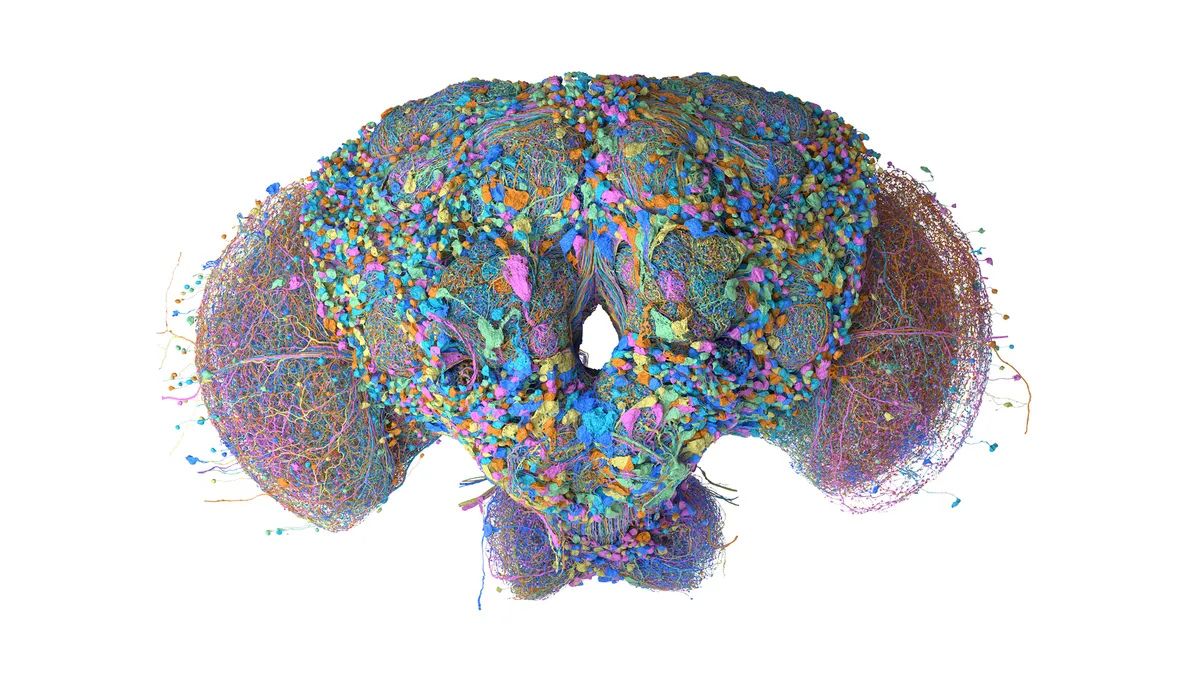
In a years-long project by HHMI Janelia Research Campus, a team in Cambridge, UK, and collaborators from the scientific community; scientists have mapped every single neural connection in the brain and central nervous system of an adult male fruit fly.
For the first time, a group of researchers — including scientists from @GoogleResearch and HHMI Janelia — built the first complete brain map for a male fruit fly. Together, we mapped every single neural connection in a male fruit fly brain and central nervous system, amounting to… pic.twitter.com/nRk8EB48xS
— Google (@Google) September 25, 2026
This map includes a record-breaking more than 166,000 neurons. It is a big step in advancing neuroscience experiments on this key model organism.
First complete brain map for a male fruit fly
A record-breaking map
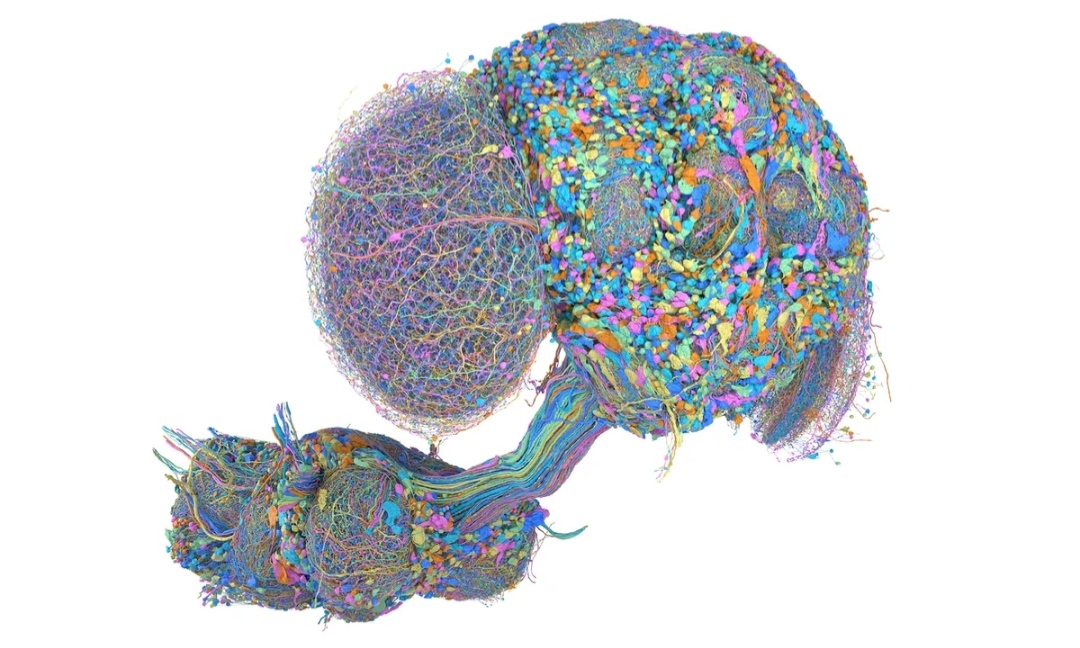
The image shows selected neurons in the male fruit fly’s brain and ventral nerve cord, which is analogous to a spinal cord.
Like humans, flies do most of their sensing using organs located on their heads, including two huge compound eyes and a retractable proboscis that extends to detect smell and ingest liquid food. Neurons in these sensing organs detect external information and pass the signal through pathways that eventually reach the motor neurons that control movement.
Brain+ Nerve Cord
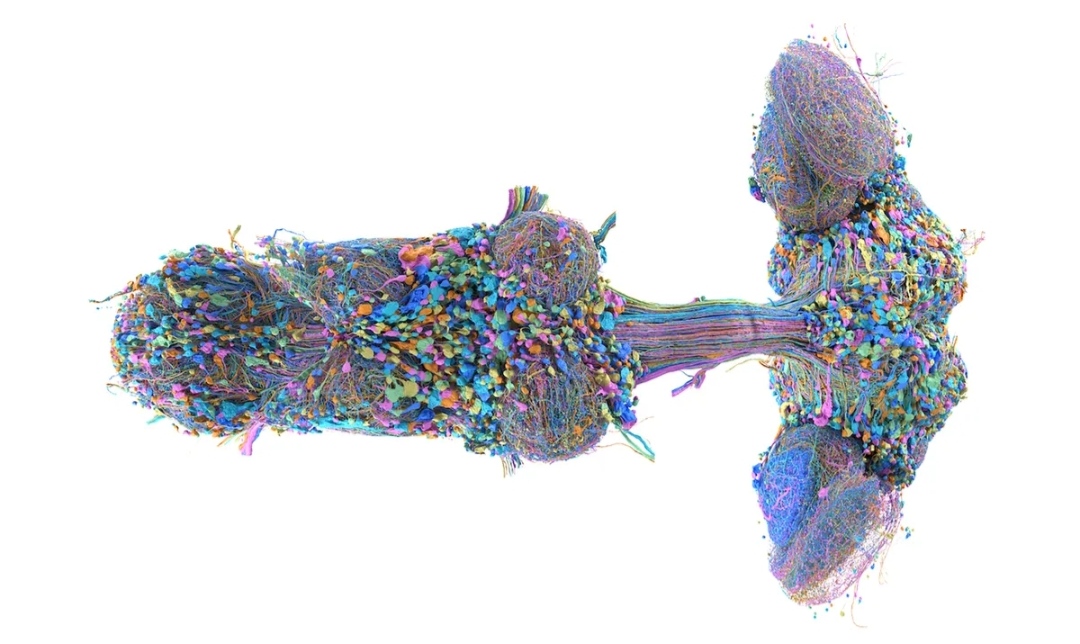
When seen from above, the fruit fly’s massive eyes and central brain stand out. They connect via a thick cord of nerves to the body, where motor neurons control behavior. This map was created by taking thin sections of a fruit fly brain and body, imaging each slice, and then using computers and AI to combine millions of 2D images to create 3D neural shapes. Knowing the structure of the brain allows neuroscientists to understand the mechanisms behind brain function.
Visualising almost 11,700 types of neurons
This video shows some of the 11,691 types of neuron cells in the male fruit fly’s central nervous system, which includes the brain and ventral nerve cord. Neurons can be categorized by size, shape, function, gene expression, or other factors. This visualization begins with neurons at the core of the brain and body. It then gradually moves to outer layers and, finally, to neurons at the extremities. Computing and AI helped human experts classify more than 166,000 neurons.
Brain differences between male and female fruit flies
While most neurons in male and female fruit flies are the same, or isomorphic, a minority are sex-specific. A third category of neurons is “dimorphic,” existing in both males and females but connecting to different neighbouring neurons. These neighbours may be isomorphic, the same in both males and females, or sex-specific, or even dimorphic themselves.
Connecting stimulus to motion
The new brain map of the male fruit fly includes visual-motor pathways. These connect the visual neurons, which help the fly detect its environment, to motor neurons, which help it move in response. This video shows an example of such a pathway, going from the R1-R6 visual neurons (purple) to the DNg13 motor neuron (green). In between are several intermediate steps, including the male-specific LoVP92, named for the so-called “love spot,” that plays a role in courtship behaviour.