

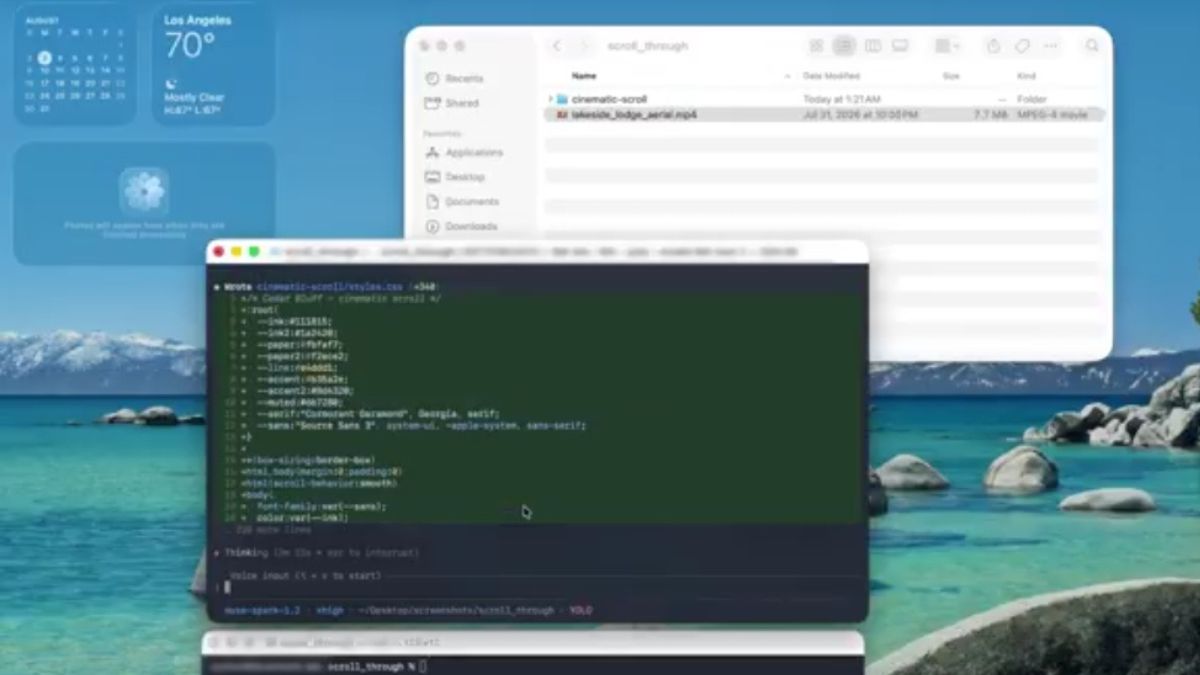
Solving complex software engineering tasks sometimes requires a lot of work and time for developers. To make this process faster, more accurate and with less intervention, Meta has introduced Muse Code (Beta).
Muse Code (Beta)
This is a terminal coding agent that is powered by Meta’s latest model, Muse Spark 1.2. Before coming to the new coding agent, let’s talk about Muse Spark 1.2.
Muse Spark 1.2
This is a coding-focused update to Muse Spark 1.1, with improvements in code generation, complex debugging, codebase understanding, and end-to-end developer workflows. In the model, Meta has significantly scaled up training compute on coding tasks while expanding training environment diversity. Meanwhile, the model is also said to maintain its strength in general agents.
The model was extensively trained on long-horizon coding tasks, including whole-repository generation, large end-to-end projects and auto-research. Meta also used Muse Spark 1.1 to generate challenging coding environments and instruction-following templates to help Muse Spark 1.2 in self-improvement and follow complex instructions more precisely than its predecessor.
Muse Code
Muse Code operates with a simple agent loop plus a set of async background agents to enhance the main agent’s capability. These specialised background agents remain active throughout each session, helping avoid redundant information gathering. They carry out next steps and choose when to communicate back to the main agent.
This new terminal coding agent uses a local event log in which every model call, tool run, approval and edit is appended. This makes the runtime replay-exact and restart-safe, and Muse Code can take on long-running tasks without being derailed by failures.
The agent ships with several default skills:
- /plan turns a task into an approval-gated plan
- /grill stress-tests that plan until it holds up
- /goal works toward successful completion of the specified objective
Both Muse Code and Muse Spark 1.2 were co-trained to ensure the model exhibits its best performance and coding usability when paired together, and focused on tasks like whole-repo generation, large projects and auto-research.
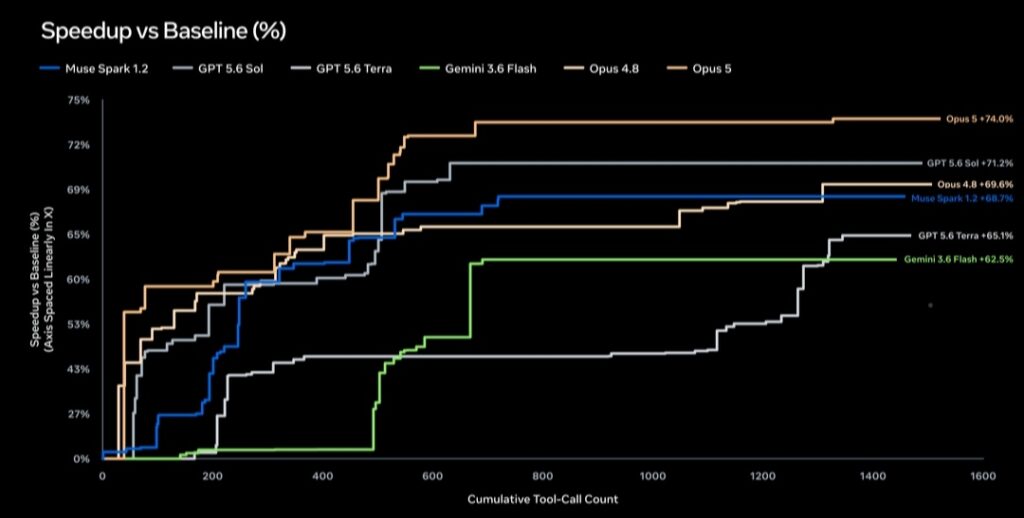
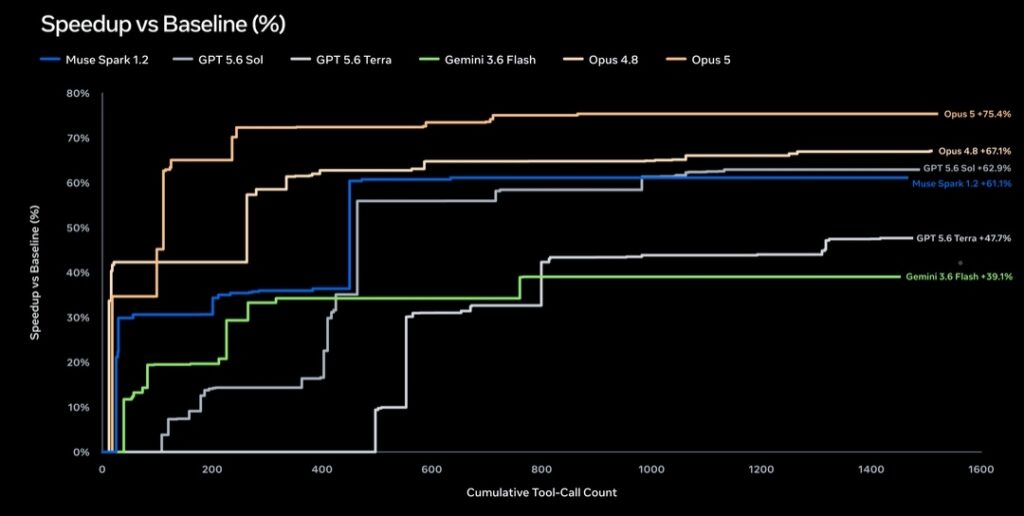
In long-horizon stress testing, Muse Code iteratively optimised GPU Kernels over 1000+ tool calls (up to 24 hours) on NVIDIA Hopper GPUs, delivering very competitive performance gains for KDA and MLA relative to baseline Triton implementations.
Availability
Muse Spark 1.2 is available today in Muse Code and in the Meta Model API with expanded global access.