

Samsung introduced its Privacy Display feature with the Galaxy S26 Ultra, which allowed users to prevent others from viewing the screen from the sides. Well, according to the latest information shared by tipster Kacper Skrzypek, Xiaomi is also testing a similar feature called Smart Privacy Display.
Here is what has been revealed.
Xiaomi Smart Privacy Display – Details
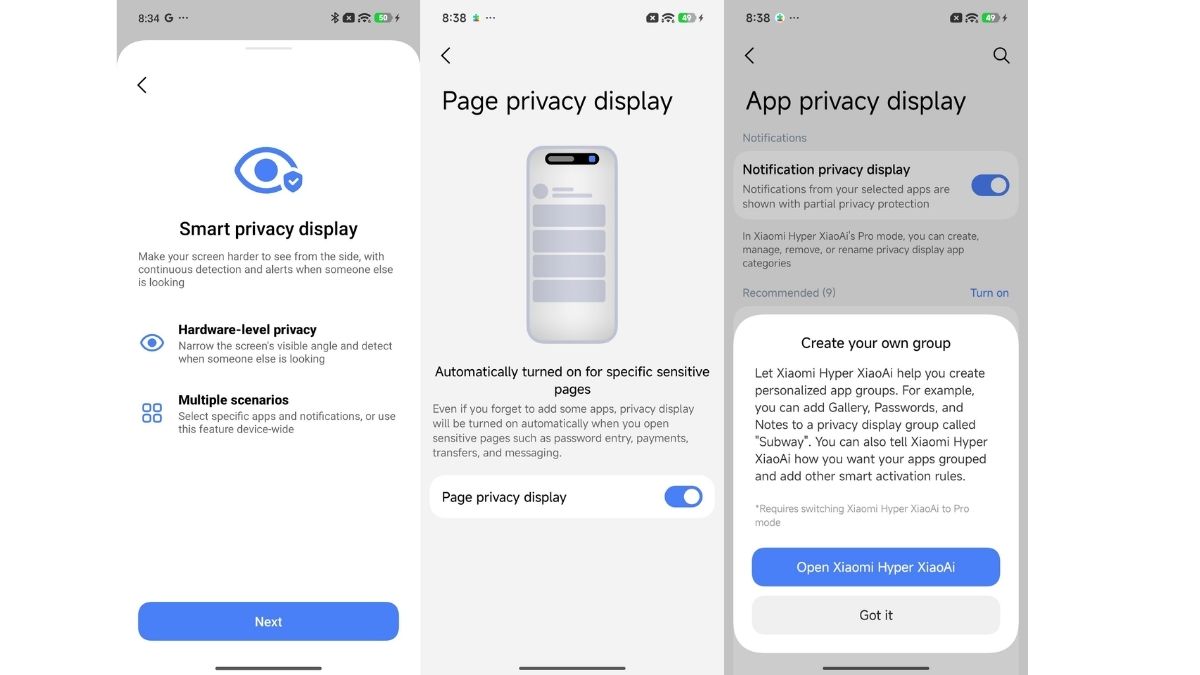
As per the details shared by the tipster, Xiaomi’s Smart Privacy Display feature narrows the visible viewing angle of the screen at the hardware level, making the on-screen content difficult for others to view from the sides.
The feature is also said to continuously detect whether another person is looking at the screen and alert the user. However, the Samsung Galaxy S26 Ultra privacy display does not continuously detect people around you; instead, it operates based on manual toggles or app-specific triggers rather than active environment surveillance.
That's how "Smart privacy display" options will look on supported #Xiaomi device (likely upcoming flagship).
Video recorded on Global ROM. "Page privacy display" and Xiaomi Hyper XiaoAi groups are, at least for now, available only on China ROM. pic.twitter.com/AigocVrasZ
— Kacper Skrzypek 🇵🇱 (@kacskrz) August 28, 2026
Additionally, the screen grab shared by him also shows that the Page Privacy Display feature gets automatically triggered if turned on whenever the user opens a sensitive page, such as a password-entry screen, payment page, money-transfer page, or messaging page. On the other hand, Notification Privacy Display provides partial privacy protection for notifications received from selected applications.
Users will reportedly be able to create, manage, remove, and rename privacy-display app categories. Moreover, Xiaomi Hyper XiaoAI can create personalised application groups and configure smart activation rules. However, creating personalised app groups will require the Xiaomi Hyper XiaoAI Pro mode. This would mean that it might be limited to the China region as of now.
The tipster also tried enabling the feature on his device, but it did not work, which, according to him, is because the menu was enabled on HyperOS3 while the application came from HyperOS4, the required code was missing, or the display lacked the necessary hardware-level support.
As of now, the exact Xiaomi smartphone that will support this feature remains unknown. When asked whether it could arrive on the vanilla Xiaomi 18, the tipster declined to speculate, though he personally expressed doubt about the possibility.
Stay tuned for more updates.