


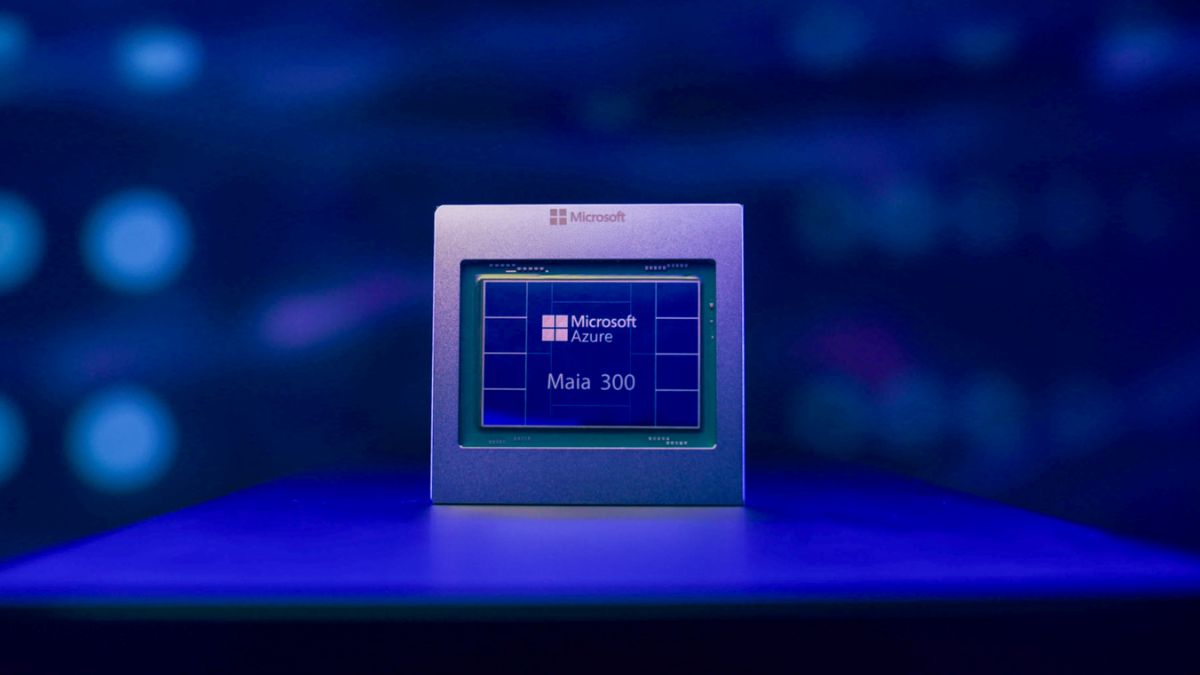
Yesterday, Microsoft announced that it will scale its Azure Maia family to multi-gigawatt deployments starting in 2027, making Maia the primary inference system for Microsoft products and services. The company also introduced Maia 300, which delivers 40% more tokens per watt compared to leading GPS-based systems.
Today we are announcing our biggest bet yet on our own silicon.
Starting next calendar year, we will scale our Maia family to multi-gigawatt deployments, making it the primary inference system for our own product and services.
And we’re introducing Maia 300, which delivers 40%… pic.twitter.com/L490XvOys9
— Satya Nadella (@satyanadella) October 12, 2026
Azure Maia System
The Azure Maia System is designed around the real-world workloads Microsoft runs at scale and the models the company expects to build in the year ahead.
Maia 200
Microsoft revealed that Maia 200 is deploying across the US, Europe, and Australia and delivering up to 1.7x more tokens per watt for built-in capabilities in Microsoft Teams, Copilot and Cowork experiences compared with leading GPU infrastructure.
Furthermore, it is revealed that the experience running Microsoft’s AI models and services on Maia 200 directly informed the design of Maia 300. Together, the two generations are designed to support a broad set of additional Microsoft AI services like multi-step agentic work, cloud-scale model serving, inference and data generation and latency-sensitive interactions.
Maia 300
It is designed with an inference-first architecture optimised for long-context, memory-intensive and decode-heavy AI workloads. This involves balancing compute, memory bandwidth, networking and power efficiency at cloud scale.
Key capabilities
- Less data movement, more useful compute: Maia 300’s software-defined dataflow architecture and AI-assisted kernel optimisation work together to maximise locality, reduce data movement and improve utilisation across compute, memory and networking resources. By treating dataflow as a first-class design principle, Maia 300 delivers a significant performance-per-watt advantage over traditional GPU architectures.
- Higher memory bandwidth within every watt: Maia 300 delivers industry-leading HBM bandwidth per watt. Eight HBM4 stacks provide 18.0 TB/s of peak memory bandwidth within a 950-watt TDP, enabling efficient execution of large models and long-context workloads.
- Chiplet architecture for enhanced efficiency: A new multi-chiplet architecture separates compute, memory-controller and I/O functions, improving efficiency, scalability and cost structure. Compute chiplets are built on TSMC’s N2P process node to maximise performance-per-watt.
- Larger context, richer intelligence: By designing for advanced low-precision formats, including enhanced MXFP4, Maia 300 reduces memory and bandwidth requirements for both computation and KV-cache storage. The result is larger context windows, higher throughput and improved model efficiency within the same power envelope.
- Scale up networking at datacenter scale: Maia 300 treats networking as a seamless extension of the software-defined dataflow architecture. Rather than moving data through separate communication layers, dataflow operations span compute, memory and network resources as a single system. High-bandwidth interconnects between Maia accelerators are optimised for tensor parallelism, while a custom AI transport delivers performant and reliable scale-up communication across accelerators and racks
- Higher AI throughput from every rack: Maia 300 rack systems bring together 96 accelerators within a 167-kilowatt power envelope, delivering 27.6 TB of HBM capacity and 1.7 PB/s of aggregate HBM bandwidth across a high-speed scale-up domain. That density allows Microsoft to serve more simultaneous AI interactions and larger workloads from each rack, improving datacenter capacity and the economics of expanding AI services.
Microsoft has announced that Maia 300 will begin production deployments in 2027.