


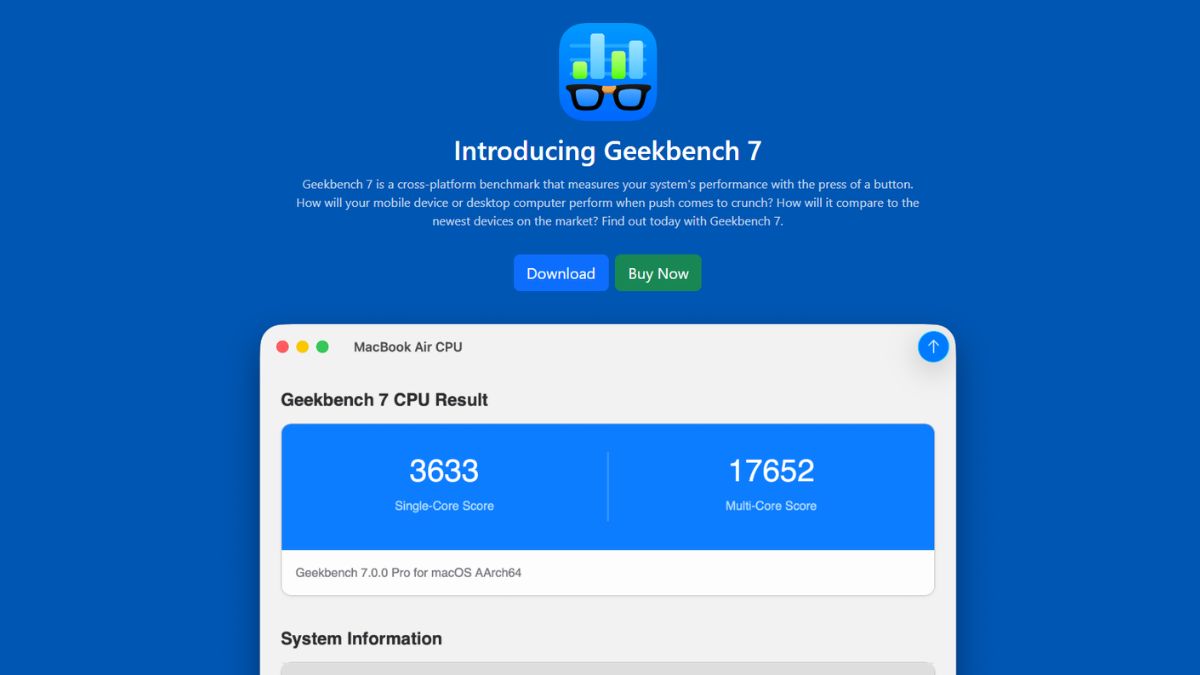
Almost three-and-a-half years after the launch of Geekbench 6, Primate Labs has officially introduced Geekbench 7, the latest version of its cross-platform benchmarking software. Interestingly, Geekbench 6 had also arrived around three years after the release of its predecessor.
Read more about it below.
Geekbench 7 Officially Released – New Features and Improvements
Starting with the new media workloads, Geekbench 7 now tests how efficiently a processor handles audio and video encoding, decoding, and processing.
The benchmark uses the AV1 codec to encode screen-sharing videos and the Opus codec to compress music and spoken-word audio. It also decodes audio and video while generating live captions using OpenAI’s Whisper speech-recognition model.
The Photo Editor workload has been expanded with more real-world editing tasks, while the Photo Library workload can now import and process modern image formats including JPEG XL and DNG.
For GPU testing, Geekbench 7 brings an increased focus on machine learning and content-creation tasks as it includes workloads for tracking faces and applying real-time filters to videos, upscaling images using machine learning, and blurring backgrounds during video conferencing.
Furthermore, new GPU image-editing and synthesis workloads have been added, including RAW image processing, LUT-based video colour grading, path tracing, fluid simulation and a new Game Physics workload based on the Jolt Physics engine has also been introduced to evaluate gaming-related CPU performance.
The multi-core CPU benchmark has been completely redesigned to better represent how modern applications use multiple processor cores. A workload will now run in multi-threaded mode only when the real application it represents actually uses multiple threads. For instance, the HTML5 Browser test has not been included in the multi-threaded suite as web browsing tasks are usually single-threaded or lightly threaded.
The GPU benchmark now supports NVIDIA’s CUDA API alongside OpenCL, Vulkan, and Metal. This allows Geekbench 7 to measure NVIDIA GPU performance using the same technology which powers demanding AI, video-editing, scientific-computing, and 3D-rendering applications.
In Geekbench 7 Primate Labs the datasets used by the benchmark has also been increased to handle the size and complexity of datasets. The File Compression workload now uses more varied archives, while the PDF Viewer test includes documents ranging from park maps to technical documents and academic papers. More assets and image formats are also used throughout the developer and image-processing workloads. Primate Labs has detailed all these changes in its official announcement.
It should be noted that Geekbench 7 scores should not be compared directly with Geekbench 6 results, as the workloads, multi-core testing method, datasets, and score-calibration hardware have changed.
Geekbench 7 is now available for Android, iOS, Windows, macOS, and Linux, and will remain free for personal use. Primate Labs is also offering a 20% launch discount on Geekbench 7 Pro until August 6th, 2026.
Stay tuned for more updates!