

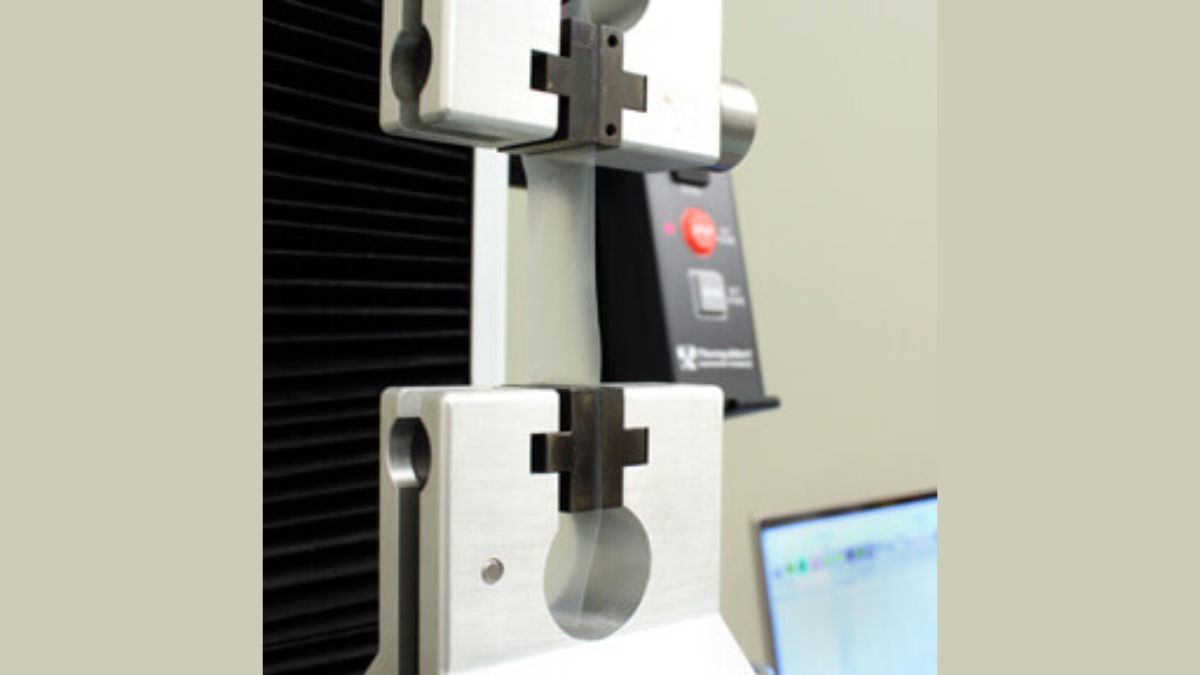
Universal testing machines (UTMs) support material validation across advanced manufacturing industries by measuring the mechanical behavior of metals, composites and other engineered materials. Engineers and testing professionals depend on accurate testing to verify structural integrity and maintain strict quality assurance standards throughout production cycles.
As organizations evaluate the cost of a UTM, many prioritize systems with artificial intelligence (AI)-assisted analytics and advanced software ecosystems that deliver improved operational efficiency in modern research and manufacturing environments.
How UTMs Support Modern Product Innovation
Engineers use UTMs to validate product durability and material performance throughout research and development processes. Because any given material has useful mechanical properties and these properties are often interrelated, engineers must be able to measure tensile strength, compression resistance and other performance characteristics with high accuracy.
Rapid prototyping and shorter product development cycles have increased the demand for fast, repeatable testing processes that support quicker design validation and more efficient iteration. UTMs also help manufacturers identify material inconsistencies and potential failure points before products move into large-scale production, which reduces quality risks and improves long-term reliability.
Industries Driving Demand for Advanced UTMs
Aerospace and automotive organizations use UTMs to assess the performance of lightweight composites and high-strength alloys designed to improve structural durability. Electronics manufacturers also rely on precision material testing to evaluate flexible circuits, connectors and packaging durability as devices become smaller and more complex.
Materials testing can determine both fresh concrete workability and mechanical performance, enabling innovative research on materials that support resilient infrastructure. Beyond traditional industrial applications, UTMs have become more indispensable in sustainable materials development and smart manufacturing environments where advanced testing data support product innovation and regulatory compliance.
Companies Offering Reliable UTMs
The following companies stand out for their strong industry reputations, advanced testing technologies and ability to support demanding quality assurance environments.
-
Thwing-Albert Instrument Company
Thwing-Albert Instrument Company is one of the nation’s leading manufacturers of advanced testing instrumentation. It has decades of industry experience and a long-standing focus on custom-built machines manufactured in the U.S. The company provides UTMs and material testing systems for the plastics, paper and textiles industries. It provides solutions for measuring tensile strength, compression resistance and coefficient of friction.
Its operations emphasize quality assurance through ISO 9001:2015 certification and an ISO/IEC 17025:2017 accredited laboratory. Thwing-Albert also focuses on application-specific customization and hands-on technical support tailored to specialized laboratory requirements. The company’s testing systems integrate touch-screen controls and various ranges of grips and fixtures that improve testing flexibility and precision.
-
Instron
Instron is a trusted provider in materials testing with more than 50,000 installations worldwide. Its portfolio includes universal testing systems, fatigue testing equipment and advanced automation platforms designed for various industrial applications. The company’s 6800 Series universal testing systems support force capacities from 0.02 N to 300 kilonewtons and offer data acquisition rates up to 5 kilohertz, highlighting the precision and scalability of its technology.
Instron’s Bluehill Universal software ecosystem, which features touch-screen workflows and AI-assisted data management, simplifies testing while improving traceability. It heavily focuses on integrated automation, robotic specimen handling and intelligent safety systems, such as its patented Operator Protect architecture.
-
MTS Systems
MTS Systems has built a strong reputation in advanced materials testing through decades of expertise in mechanical testing, simulation technology and high-performance engineering solutions. The company offers Criterion electromechanical systems and dynamic simulation technologies designed for tensile, compression and fatigue testing applications. Its Landmark systems deliver repeatable results across standard tension testing and thermomechanical fatigue studies.
MTS emphasizes scalable software ecosystems through MTS TestSuite and FlexTest controllers that support high-speed closed-loop control and international testing standards. The brand specializes in dynamic and simulation-based testing environments capable of supporting highly demanding research applications. Its systems can evaluate reinforced concrete and biomedical materials, which reflects the company’s strong presence in research-intensive industries.
Comparing Leading UTM Manufacturers
Selecting the right testing equipment provider often involves more than comparing load capacities and software features alone. Differences in industry specialization, automation capabilities and testing flexibility can influence laboratory performance and research efficiency.
| Company | Primary Industry Focus | Notable Testing Capabilities | Software and Automation Strengths |
| Thwing-Albert Instrument Company | Packaging, plastics, textiles, paper and flexible materials | Tensile, compression, peel, friction and seal strength testing | MAP4 software, configurable testing workflows and compact lab integration |
| Instron | Aerospace, automotive, electronics and advanced manufacturing | Tensile, fatigue, flexure, puncture and dynamic materials testing | Advanced automation platforms, robotic integrations and enterprise-grade analytics |
| MTS Systems Corporation | Aerospace, civil engineering, automotive and biomedical sectors | Static, dynamic, fatigue and high-force materials testing | High-speed data acquisition, simulation-focused systems and scalable automation |
Methodology Behind Selecting the Companies on This List
The featured companies offer technical performance, long-term reliability and industry relevance. Alongside the cost of a UTM, the evaluation also considered how effectively each manufacturer supports advanced manufacturing requirements.
- Testing accuracy: Demonstrate measurement precision and consistency across tensile and compression applications.
- Machine reliability: Produce durable systems that maintain stable performance in demanding laboratory and industrial environments.
- Industry reputation: Has a strong presence in the materials testing sector and has been adopted across the aerospace and manufacturing industries.
- Software capabilities: Integrate automation tools and integrated software ecosystems that improve testing efficiency and data interpretation.
- Standards compliance: Manufacturers make systems that support widely recognized ASTM, ISO and other international testing standards.
- Service and scalability: Businesses prioritize calibration support, maintenance services and the ability to scale systems for future testing requirements.
How Much Does a UTM Typically Cost?
Pricing and universal testing systems vary widely based on load capacity, automation features, software sophistication and intended testing applications. Entry-level benchtop systems designed for laboratory research or light industrial testing generally cost far less than high-capacity industrial platforms built for infrastructure engineering environments.
Organizations searching for a UTM machine for sale often discover that additional technologies significantly affect pricing, especially when environmental chambers and AI-assisted analytics software are included. In some specialized applications, a typical fatigue testing training device may range between $10,500 and $32,500, depending on system complexity and testing functionality.
Common Mistakes Buyers Should Avoid
Organizations that select UTMs solely on maximum load capacity may overlook critical application-specific requirements, such as testing speed, fixture configurations and material sensitivity. Insufficient software capabilities can also limit reporting accuracy and create scalability challenges as laboratories adopt more advanced compliance requirements.
When evaluating a UTM quote, many buyers fail to consider the long-term impact of calibration services, software updates and future upgrade flexibility on operational efficiency and ownership costs. Overlooking these factors can result in inconsistent testing performance and higher expenses over the equipment’s lifespan.
Choosing Reliable Universal Testing Technology for Long-Lasting Performance
Reliable UTM solutions combine measurement accuracy, software intelligence and cservice support to meet the modern industry demands. Technology professionals should also assess automation capabilities and data management tools before investing. Careful evaluation of a UTM’s cost, testing performance and long-term operational adaptability helps manufacturers maintain compliance and support ongoing product innovation.