


India’s textile heritage is celebrated across the world. From the intricate Banarasi silks woven in the lanes of Varanasi to the enduring legacy of khadi, textiles have long been intertwined with the country’s cultural identity and economic development. Yet behind these celebrated traditions lies a quieter story; one of the women whose labour sustains the industry, but whose contributions often remain undervalued and undercompensated.
For Samriddhi Shah, a Grade 11 student at The International School Bangalore (TISB), this reality became impossible to ignore. With family roots in Varanasi, one of India’s most prominent textile hubs, Shah witnessed how women artisans played a central role in preserving centuries-old crafts while simultaneously facing systemic barriers to economic advancement.
That observation would eventually lead to the creation of Kaari Naari, an initiative dedicated to advancing financial inclusion, vocational development, and economic empowerment for women across India and Bangladesh.
What began as a grassroots effort has evolved into a movement that has reached more than 10,000 women and expanded across two countries and over twenty Indian cities. At its core lies a simple belief; women should not merely participate in economic systems, they should have the knowledge, agency, and tools required to benefit from them.
The need for such interventions is particularly evident within India’s textile sector.
Historically, women have constituted a substantial portion of the textile workforce. They have worked as weavers, embroiderers, stitchers, dyers, and artisans, serving as custodians of skills passed down through generations. Yet despite their indispensable role, female participation in the textile labour force has declined significantly over the past two decades.
Industry data indicates that female labour force participation in India’s textile sector fell from approximately 31 percent in 2000 to 24 percent in 2021. While the reasons are multifaceted, unequal access to resources, information, professional opportunities, and financial systems continues to create significant obstacles for women seeking economic mobility.
The challenge extends beyond employment figures.
Across numerous textile clusters and artisan communities, women often remain disconnected from the value generated by their own work. Intermediaries frequently control market access, pricing structures, and payment processes, creating an environment in which artisans possess limited visibility into how their products are sold and valued. The resulting information asymmetry can lead to delayed payments, unexplained deductions, and inequitable remuneration.
In many instances, artisans create products that command substantial value in domestic and international markets, yet receive only a fraction of the final revenue generated. The absence of transparent systems makes it difficult for women to verify whether they are being compensated fairly for their labour.
For Shah, addressing these challenges required more than awareness campaigns; it required equipping women with the practical tools needed to navigate economic systems independently.
Financial literacy became the first step.
Through Kaari Naari’s workshops and outreach programs, more than 10,000 women have received training in budgeting, savings, banking access, digital payments, and entrepreneurship. For many participants, these sessions represented their first interaction with formal financial institutions.
The significance of such exposure cannot be overstated. Financial literacy is often viewed as a technical skill, yet it also functions as a catalyst for economic confidence. Women who understand banking systems and financial planning are better positioned to make informed decisions, access opportunities, and participate more actively in local economies.
However, knowledge alone cannot generate livelihoods.
Recognizing this, Shah expanded Kaari Naari’s work to include vocational training initiatives focused on stitching and textile production. More than 500 women have received specialized training through these programs, enabling them to develop marketable skills and secure employment opportunities within the textile ecosystem of Banaras.
The objective has always been long-term economic participation rather than short-term intervention.
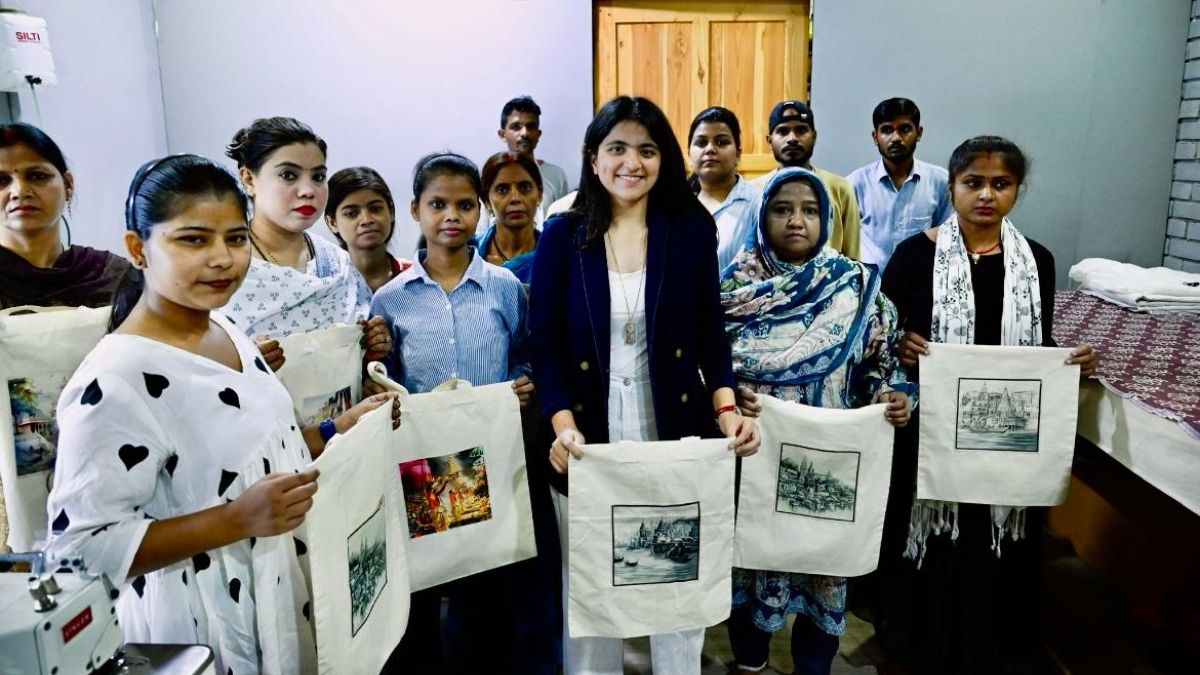
Among the initiative’s most notable projects has been a collaboration with women artisans to produce khadi tote bags that celebrate local identity and craftsmanship. Featuring designs inspired by the towns and communities in which they were created, the bags served as both a source of income and a platform for promoting regional artisanship.
The project demonstrated how traditional skills could be adapted for contemporary markets while simultaneously generating livelihood opportunities. It also reinforced a recurring observation.
Even when women were responsible for creating products, they often lacked access to information regarding pricing, sales, and revenue distribution. Their craftsmanship was visible; their economic participation was not always equally visible.
This realization would eventually guide Shah toward a field not typically associated with artisan communities: blockchain technology.
Working under the guidance of Miss Twinkle Chatterjee from IIT Kharagpur, Shah has explored how blockchain-based systems can be used to create greater transparency within value chains. She is currently developing a framework that seeks to address longstanding concerns regarding compensation, accountability, and traceability for women artisans and weavers.
While blockchain is frequently discussed in the context of finance and digital assets, its underlying value lies in transparency. By creating secure and tamper-resistant records, blockchain systems can provide a verifiable history of transactions, payments, and ownership.
Applied to artisan ecosystems, such technology could help women track orders, verify payments, and access transparent records detailing how revenues are distributed throughout the supply chain. It could also reduce opportunities for unfair deductions and increase accountability among stakeholders.
The ambition is not to replace traditional craftsmanship with technology; rather, it is to use technology to safeguard the interests of those whose craftsmanship sustains entire industries.
For Shah, innovation is most meaningful when it addresses real-world inequities. Her work reflects a broader understanding that economic empowerment cannot be achieved through a single intervention. Financial literacy, vocational development, cultural preservation, and technological innovation must work in concert to create lasting change.
Balancing her academic commitments at The International School Bangalore with a rapidly expanding social-impact initiative, Shah represents a new generation of young leaders who are redefining how technology can be used to advance social progress.
As India’s textile industry continues to evolve, conversations surrounding sustainability, digitization, and inclusive growth will become increasingly important. Ensuring that women artisans are not merely contributors to that future, but active beneficiaries of it, may prove to be one of the sector’s defining challenges.
Through Kaari Naari, Samriddhi Shah is working toward a future where the women who create value can see it, track it, and ultimately retain a fair share of it. In an industry built upon heritage and craftsmanship, that vision may be one of the most transformative innovations of all.