



A fresh Geekbench AI listing of Samsung’s upcoming flagship chipset, which is believed to be the Exynos 2700, has now been spotted, revealing its AI scores, 10-core CPU configuration and clock speeds.
Read more about the update below.
Alleged Samsung Exynos 2700 – Geekbench AI Listing
On the Geekbench AI platform, a Samsung engineering reference device carrying the model name ‘Samsung Electronics Co., Ltd. Full Android on S5E9975 ERD’ has been listed with the motherboard codename ‘s5e9975’, which is believed to be associated with the upcoming Exynos 2700 chipset. While the listing itself does not explicitly confirm its marketing name, the source code of the page further points to the presence of the Xclipse 970 GPU.
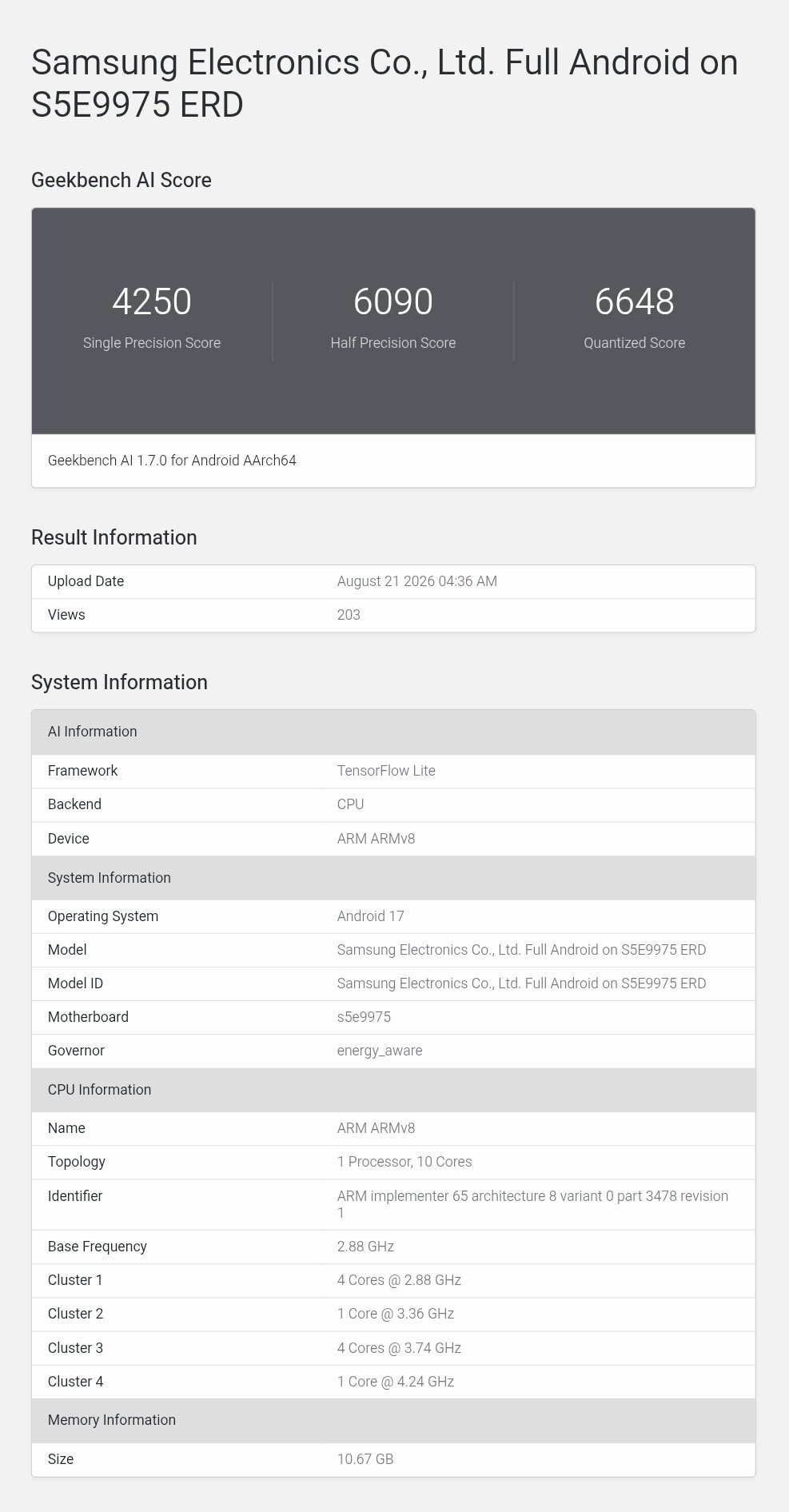
Coming to its Geekbench AI performance, the alleged Exynos 2700 achieved a single-precision score of 4,250 points, a half-precision score of 6,090 points and a quantized score of 6,648 points.
Speaking more, the listing reveals a four-cluster, 10-core CPU configuration. The first cluster consists of four cores clocked at 2.88GHz, while the second cluster has one core clocked at 3.36GHz. The third cluster includes four cores clocked at 3.74GHz, whereas the fourth cluster features one core clocked at 4.24GHz.
Furthermore, the test device is pointed out to have 10.67GB of memory, suggesting that it could be equipped with 12GB of RAM.
Well, this is not the first time that the alleged Exynos 2700 chipset has appeared on Geekbench. Back in January 2026, an early Geekbench listing of the alleged chipset revealed its four-cluster, 10-core CPU architecture and Xclipse 970 GPU.
In the previous listing, one core was clocked at 2.30GHz, four cores were clocked at 2.40GHz, one core operated at 2.78GHz and the remaining four cores were clocked at 2.88GHz. The latest listing therefore points to considerably higher clock speeds, with the highest-performing core now reaching 4.24GHz.
Additionally, the existing Exynos 2600 uses a triple-cluster, 10-core CPU configuration consisting of six cores clocked at 2.76GHz, three cores clocked at 3.26GHz and one core clocked at 3.80GHz. The alleged Exynos 2700’s four-cluster configuration therefore suggests that Samsung could be experimenting with a different CPU architecture approach for its next flagship chipset.
Exynos 2700 Reportedly Outperforms Snapdragon 8 Elite Gen 6 in Samsung’s Internal Tests
Moreover, South Korean news agency Yonhap has reported that Samsung’s MX division recently conducted internal benchmark tests involving the Exynos 2700, Snapdragon 8 Elite Gen 6 and its higher-end Pro variant. The alleged Exynos chipset reportedly delivered better results across CPU, GPU, AI and power-efficiency tests.
In Geekbench 6.5 multi-core testing, the Exynos 2700 reportedly achieved a 19% higher score than the standard Snapdragon 8 Elite Gen 6 and a 9.5% higher score than the Snapdragon 8 Elite Gen 6 Pro.
Coming to its graphics performance, the chipset is said to offer 5% higher peak GPU performance than the Snapdragon 8 Elite Gen 6 Pro. Under a low-power testing condition of 2.5W, its performance advantage reportedly increased to 24% over the standard Snapdragon 8 Elite Gen 6 and 22% over its Pro variant.
Speaking more, in testing involving the Llama 3.1 8B model, the Exynos 2700 reportedly generated responses 18% faster than the Snapdragon 8 Elite Gen 6 Pro. It is also said to have delivered around 5% faster prompt recognition and processing than the Qualcomm chipset.
BREAKING!
Korean media reports that Samsung is highly confident in its next-generation flagship chipset, the Exynos 2700, which is reportedly targeting performance beyond Qualcomm’s upcoming Snapdragon 8 Elite Gen 6, including the higher-end Pro variant.
According to the…
— Ice Universe (@UniverseIce) August 23, 2026
The Exynos 2700 is also reported to have consumed 161mA during a test simulating real-world smartphone usage. In comparison, the Snapdragon 8 Elite Gen 6 Pro consumed 185mA under the same testing conditions, suggesting that Samsung’s upcoming chipset used around 12.7% less power.
However, it must be noted that these figures are said to have originated from Samsung’s internal testing and are yet to be independently verified. The performance of the final chipset could also vary depending on its production configuration, software optimisation and the smartphone in which it is used.
Looking into its manufacturing process, the Exynos 2700 is expected to be produced using Samsung Foundry’s second-generation 2nm GAA process, called ‘SF2P’. The company is reportedly focusing on improving power efficiency, thermal management and overall performance with its next-generation flagship chipset.
The report further suggests that Samsung could expand the use of the Exynos 2700 across its upcoming Galaxy S27 series if the chipset achieves its targeted performance. This could also help the company reduce its dependence on flagship processors supplied by Qualcomm.
Notably, Samsung reportedly spent KRW 7.4383 trillion on mobile application processors supplied by companies such as Qualcomm and MediaTek during the first half of 2026. This amount is said to account for 17.9% of the total raw-material expenses of Samsung’s Device eXperience division.
The Galaxy S26 and Galaxy S26+ were launched with Samsung’s Exynos 2600 chipset, while the Galaxy S26 Ultra features Qualcomm’s Snapdragon 8 Elite Gen 5 processor. With the Exynos 2700 reportedly showing competitive performance during Samsung’s internal tests, its adoption could be expanded further with the next-generation Galaxy S27 lineup. However, the exact Galaxy S27 models and regional variants that will use the chipset are currently not known.
Since the latest Geekbench result appears to originate from an engineering reference device, the clock speeds, CPU configuration and performance figures may change before the chipset enters production. It is also too early to comment on its final performance or Galaxy S27 availability, and more details are expected to be revealed in the coming months.
Stay tuned for more updates.