

Following Anthropic’s Project Glasswing and OpenAI’s Daybreak, the American technology giant – Google has now brought out its own AI-powered cyber security platform called Google AI Threat Defense. This latest platform has been designed to counter the growing pace of AI-powered cyberattacks by moving from manual vulnerability management to an autonomous and machine-speed defence system.
Here’s more about it.
Google AI Threat Defense Officially Introduced
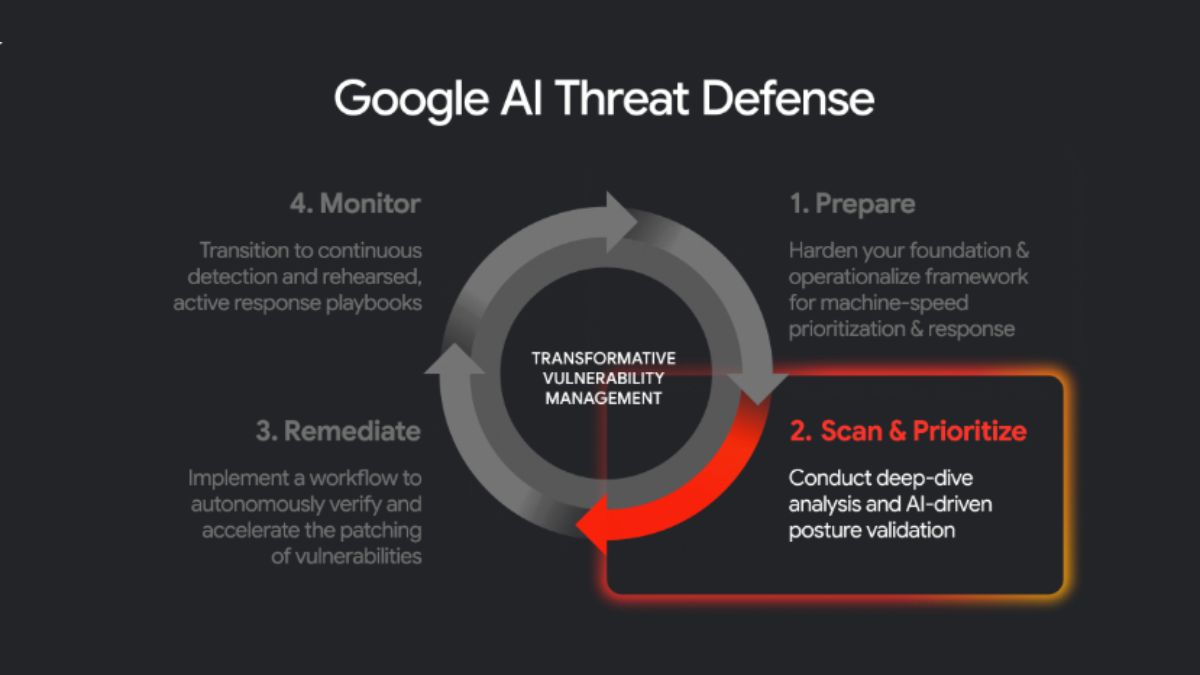
With the newly-introduced Google AI Threat Defense, the brand has integrated the capabilities of Gemini, Wiz, CodeMender, and Mandiant across a four-step operational framework. As per what has been shared, the platform focuses on preparing the security foundation, scanning and prioritizing risks, remediating vulnerabilities, and monitoring threats with continuous detection and active response playbooks.
Google has also pointed out that code scanning alone is not sufficient, and for this, Wiz will be used to continuously map live environments and validate risks with real-world exposure context. Furthermore, while the more expensive frontier models will be reserved for deep analysis of high-risk and internet-facing assets, faster and lightweight models, on the other hand, will be used for broad and continuous environmental coverage.
Quite recently, a news broke out in which PocketOS founder Jer Crane reported via his X handle that an AI coding agent – Cursor running Anthropic’s flagship Claude Opus 4.6, deleted its production database and all volume-level backups in a single API call to Railway, PocketOS’ infrastructure provider, in just 9 seconds. This is where Google’s AI Threat Defense seems relevant, as before a fix goes live, the platform automatically generates tests to verify the patch, while also tagging and tracking the changes end-to-end from source control to production.
Compared to OpenAI Daybreak and Anthropic’s Project Glasswing, Google AI Threat Defense focuses more on full-stack cloud and operational security, covering infrastructure, code, and SOC-related areas. OpenAI Daybreak is more focused on resilient-by-design software development within repositories and developer workflows, while Anthropic’s Project Glasswing focuses on using Claude Mythos Preview to find and fix vulnerabilities in critical software systems.
Google’s platform is powered by Gemini, CodeMender, Wiz AI Agents, and Mandiant’s frontline expertise, while OpenAI Daybreak makes use of GPT-5.5, GPT-5.5 with Trusted Access for Cyber, GPT-5.5-Cyber, and Codex Security. Anthropic’s Project Glasswing, on the other hand, is powered by Claude Mythos Preview and is being used by its partners for vulnerability discovery and remediation across important software systems.
Stay tuned for more updates.