

NASA’s Psyche spacecraft has now successfully completed its close flyby of Mars on the 15th of May 2026, coming within about 2,864 miles (~4,609 kilometers) of the planet’s surface. The Mars flyby was carried out in order to use the Red Planet’s gravity as a boost mechanism so as to increase the spacecraft’s speed and also alter its orbital plane without making use of onboard propellant. Following the maneuver, the spacecraft is now confirmed to be on the correct trajectory toward the metal-rich 16 Psyche asteroid located between Mars and Jupiter in the main asteroid belt.
Here’s more about it.
NASA’s Psyche Spacecraft Successfully Completes Mars Flyby
After the successful flyby maneuver, NASA’s flight team analyzed radio signals exchanged between the spacecraft and the agency’s NASA Deep Space Network so as to verify that the spacecraft was moving along the planned trajectory. As per Don Han – Psyche’s navigation lead at Jet Propulsion Laboratory, the Mars gravity assist has now provided the spacecraft with a speed boost of around 1,000 miles per hour while also shifting its orbital plane by nearly one degree relative to the Sun. With this, the spacecraft is now expected to arrive at asteroid Psyche in the summer season of 2029.
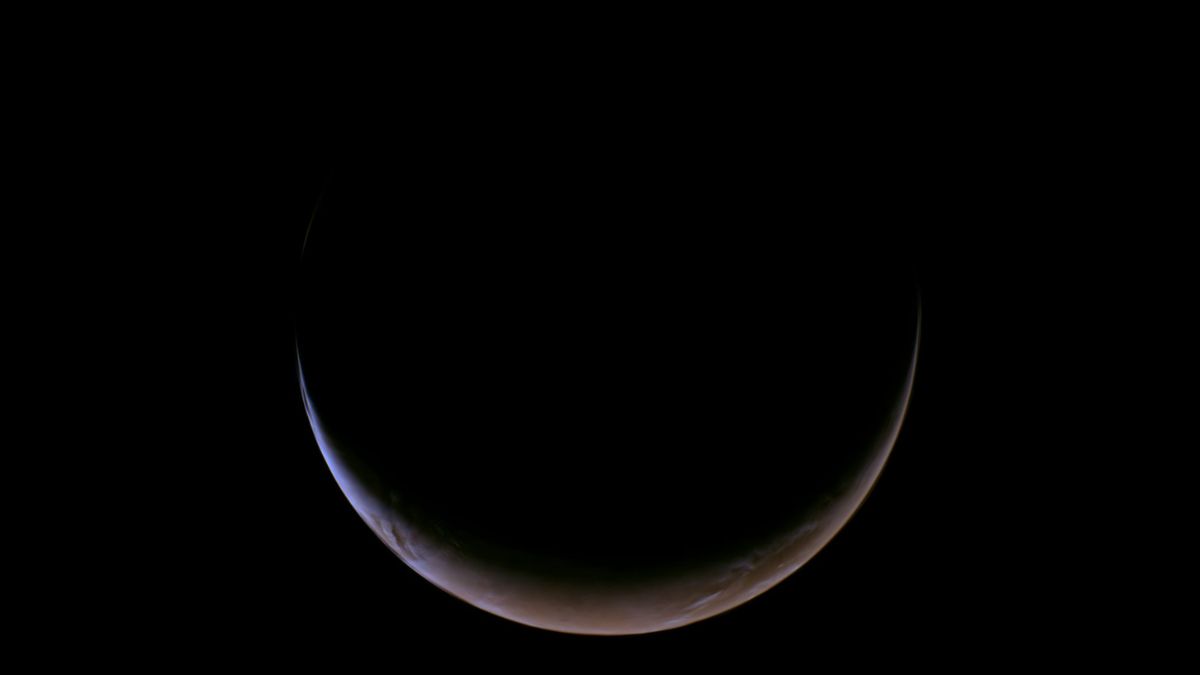
Ahead of and during the close approach, all scientific instruments onboard the spacecraft were powered up as part of various calibration activities. This included the imagers, magnetometers, and gamma-ray and neutron spectrometer instruments. The Mars encounter also offered a valuable testing opportunity for the mission team before the spacecraft eventually reaches asteroid Psyche. In addition to this, the spacecraft was also able to capture unique images of Mars from a rare viewing angle.
Because the spacecraft approached Mars from a high phase angle, the planet appeared as a thin crescent illuminated by sunlight reflected from its surface. Observations captured using the spacecraft’s multispectral imaging system revealed that the crescent appeared brighter and stretched farther across the planet’s disk than initially expected due to the scattering of sunlight through Mars’ dusty atmosphere. Around the moment of closest approach, the spacecraft also captured a rapid sequence of surface images while transitioning from the nighttime side of Mars toward daylight.
Jim Bell – the Psyche imager instrument lead at Arizona State University, also revealed that thousands of images of Mars and its atmosphere had been captured during the flyby process. As per him, the collected data will help the mission team calibrate the spacecraft cameras and improve image processing tools that are currently being developed for use once the spacecraft reaches asteroid Psyche.
It has also been revealed that several other Mars missions contributed complementary imaging and navigation data during the flyby. These include NASA’s Perseverance rover mission, Mars Reconnaissance Orbiter, 2001 Mars Odyssey, Curiosity rover, along with the European Space Agency missions Mars Express and ExoMars Trace Gas Orbiter.
With Mars now behind it, the spacecraft is expected to resume its solar-electric propulsion journey toward the asteroid belt. Upon arrival in August 2029, the spacecraft will enter orbit around asteroid Psyche, which scientists currently believe could be the exposed metallic core of an ancient planetesimal. Through multiple orbital phases at varying altitudes, the spacecraft will map the asteroid and gather scientific data in detail. If confirmed to be a metallic planetary core, the asteroid may provide researchers with valuable insight into the interiors of rocky planets such as Earth.
Stay tuned for more updates.