

In recent years, humanoid robots have become quite popular in the market. But have you ever heard of a humanoid robot performing a medical surgery?
For the first time, doctors have completed two surgeries with the use of remotely controlled humanoid robots. According to the study published in Nature, “In Vivo feasibility study of humanoid robots in surgery”, it was revealed that a team of engineers and surgeons at the University of California San Diego has demonstrated that teleoperated humanoid robots can successfully perform live minimally invasive surgery during preclinical trials.
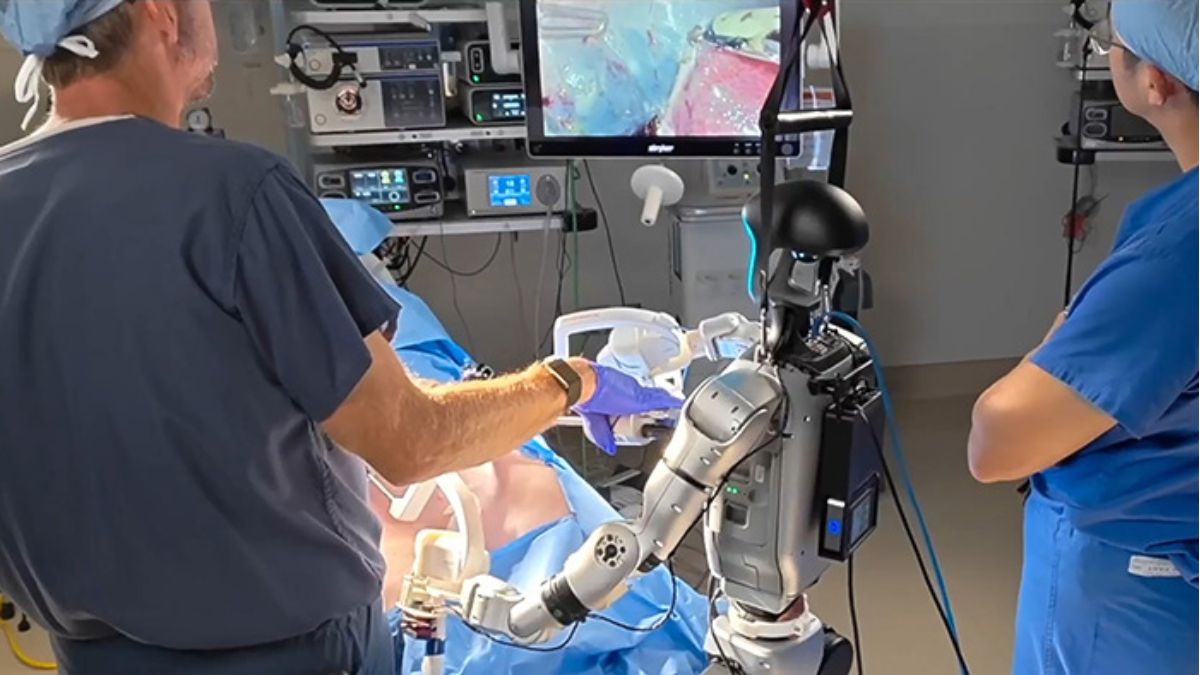
In one surgery, a human-robot team made up of a humanoid robot and a human surgeon acting as an assistant successfully performed a gallbladder removal. A second successful surgery was performed by two humanoid robots working side by side in a robot-robot team, while surgeons controlled them remotely. Both procedures were performed on large non-primate mammals.
It is revealed that the robots used in the study, nicknamed Surgie, are 5 feet tall and weigh 60 pounds. The robots were designed to work with standard laparoscopic instruments rather than custom-built surgical hardware. This latest achievement moves humanoid robots beyond laboratory demonstrations and simulated surgical exercises. The research team measured how close current humanoid systems are to the standards expected in real surgical environments.
It was observed that the humanoid robots were able to operate within an existing operating room environment. Although researchers did have to build adapters to allow Surgie to hold traditional surgical tools, controlling humanoid robots felt more natural to them.
One of the assistant professor of surgery at the UC San Diego School of Medicine said, “It’s a fraction of cost and it takes a fraction of the space in an operating room. So it’s easy to deploy, anywhere from rural areas, to the battlefield, and even to space.”
Healthcare systems in many countries are facing a shortage of surgeons; this leads to delays in the treatment of patients, widening disparities, and more. The use of humanoid robots is expected to expand access to surgical care to more patients and locations.
Apart from this major achievement, the researchers did go through some adjustments like robots had to be reclibrated several times during surgery, and latency is also being improved. Researchers also discovered a different role for surgie- it could fetch tools for the surgeons and could clean up an operating room after a procedure.
Via.