

Tinder officially introduces Double Date Mode and College Mode; Here’s what Sr. Director of Global Product Marketing at Tinder has to day about these modes

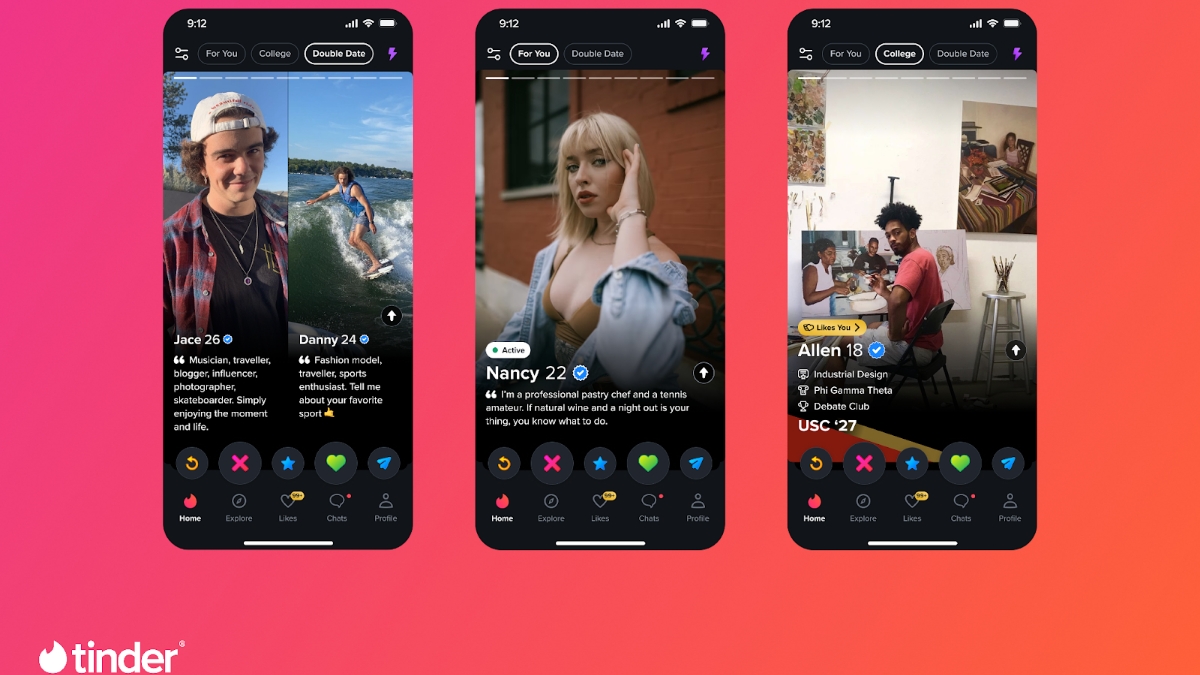
Back in June, a Double Date feature was introduced on Tinder that allowed users to find their perfect match in a pair. Tinder has now turned this feature into a dedicated mode, while there is also a College mode that was introduced along with Double Date Mode.
Double Date Mode & College Mode: Introduced on Tinder
Yesterday, Tinder introduced Modes, a new way for users to match on their terms and find connections that better align with their vibe. The Modes Navigation Bar sits at the top of the Tinder home screen, which currently includes For You Mode, Double Date Mode, and College Mode.
For You Mode lets you see everyone in one place, just like the classic Tinder experience, while Double Date mode and College mode let you step into spaces designed to make it easier for you to dive into the Tinder mode of your liking.
Double Date Mode
Double Date Mode now offers a dedicated space to browse other pairs, making it easier to connect with users looking for the same type of match. As per the company, they saw strong engagement, including Double Date users sending nearly 25% more messages per match than in 1:1 chats, and nearly 15% of users who accepted a Double Date invite being either new to Tinder or recently activated.
College Mode
College Mode is built on the success of Tinder U, that has said to increase enrolment by nearly 90% each year since 2024. College Mode compiles other college users in one place. Users can switch to this mode and see college-specific profile elements, including where others attend school, graduation year, major, Greek life, and clubs. It helps users in meeting new people from their own or nearby campuses, including those who don’t live directly on campus.
Availability
The Modes Nav bar and Double Date mode are now available globally, with College Mode gradually becoming available to eligible US users later this fall, across both iOS and Android.
Tinder is planning to introduce more modes that go beyond the basics, catering to unique interests, intentions, and ways of connecting.
In an exclusive Q&A with Cleo Lon, Sr. Director, Global Product Marketing at Tinder, some more in-depth details are revealed related to these new modes. Check it out below.
Q&A attributed to Cleo Lon, Sr. Director, Global Product Marketing at Tinder
How do Modes differ from the traditional Tinder experience?
Modes centers on choice and intentionality. In the traditional Tinder experience, you’re browsing a wide pool of people all in one place. With Modes, we’ve created a way for members to tailor their experience to what feels right for them in the moment. For example, College Mode pulls together students from your campus or nearby schools, while Double Date Mode lets pairs connect directly with other pairs. It’s a more focused way to explore the type of connections you’re looking for. The feedback we heard from Gen Z was that they wanted more fun, low-pressure ways to connect, and Modes is a continuation of exactly that. They layer on flexibility and relevance to the classic Tinder experience. Modes reflect how Gen Z approaches dating. Sometimes it’s about meeting someone one-on-one, sometimes it’s about bringing friends along, and sometimes it’s about connecting within your campus community. Modes give them the tools to do all of that within Tinder.
What was the main purpose behind introducing these Modes?
The main purpose of introducing Modes was to give our members more control and intentionality over their Tinder experience. We heard consistently from Gen Z that how they want to date can shift from day to day, sometimes it’s about meeting someone one-on-one, other times it’s about bringing friends along. Modes lets users choose the context that feels right for where they’re at in that moment.
What unique challenges did you face while developing Double Date Mode, given that it involves two pairs interacting instead of just two individuals?
One of the biggest challenges in developing Double Date Mode was that it’s fundamentally a different dynamic than one-on-one dating. Instead of just two individuals interacting, we had to design for two pairs of friends, meaning four people with their own personalities, preferences, and expectations. From a product perspective, that meant building a system that could respect each person’s individual identity and preferences, while still presenting them as part of a pair. For example, each user keeps their own profile and discovery settings, and the algorithm ensures that pairs are surfaced when they meet at least one person’s criteria. Balancing that logic in a way that felt natural and not overly complicated. What’s exciting is that those design choices have really paid off. We’ve seen higher engagement, stronger retention, and more meet-up intent from Double Date than from traditional one-on-one matches.
Based on the figures you shared, what do you think contributed most to the success of Double Date Mode?
The biggest factor was that Double Date Mode tapped directly into how Gen Z was already dating. We knew from our research and from our Year in Swipe™ report that nearly half of young singles planned to lean on friends to help navigate dating in 2025, so we leaned into that behavior. Double Date Mode simply formalized that behavior within the app, which is why nearly 85% of users adopting it are 18–29, and why women in particular are three times more likely to Like a pair compared to solo profiles. The experience resonates because it feels authentic to how this generation already navigates meeting new people. On top of that, the dedicated Mode structure streamlined the experience, making it easy for pairs to find other pairs without having to sift through the broader app. That combination of authenticity, fun, and simplicity appears to be what drove the strong engagement numbers we’ve seen.
Since students were already using Tinder, what was the idea behind launching a dedicated College Mode?
Students have always been a huge part of Tinder’s community, but one thing we heard consistently was that they wanted more control over their experience. With Tinder U, we saw incredible momentum. Enrollment grew nearly 90% year over year since 2022, but the feedback was that all profiles (college and non) still lived in one place, which made it hard to specifically find other students. College Mode provides undergrads a dedicated space to connect with other students, with profiles highlighting things like school, major, graduation year, and campus life. Instead of blending in with the broader app, students can now toggle into an experience that feels more clearly made for them. The idea was to take what was already working with Tinder U and evolve it into something more intentional, streamlined, and aligned with how Gen Z wants to date, low-pressure, authentic, and community-driven.
What safety features are in place to ensure that only verified students can access College Mode?
College Mode builds on the foundation we created with Tinder U, which was designed from the start to be a students-only experience. Users who are already verified through Tinder U, as well as most who list ‘In College’ as their education status, can access College Mode. And we’re continuing to refine the experience based on user feedback to ensure it truly meets the needs of the students it was designed for. On top of that, Tinder’s existing trust and safety tools carry over like reporting, blocking, and in-app education prompts such as Are You Sure? and Does This Bother You?. These layers work together to maintain a safe, respectful environment while still keeping the experience low-pressure and fun.
Looking ahead, how do you plan to evolve College Mode to keep it relevant for Gen Z?
College Mode is just one piece of a much bigger vision with Modes. What’s exciting is that Modes is an evolution of features that were already resonating like Tinder U and Double Date, but now Gen Z has more choice and control over how they connect. Looking ahead, this is really just the beginning. We see Modes as a way to move beyond the basics, creating spaces tailored to different interests, intentions, and styles of dating. For Gen Z, that flexibility is key, because the way they approach relationships is constantly evolving, and we want Tinder to evolve right alongside them.
