


For an individual with autism, the real challenge often lies not in knowing what needs to be done, but in the actual act of doing it. What often appears to be procrastination is, in reality, a brain overwhelmed with information, sensory input, and expectations, leading to an almost complete inability to act. This raises a crucial question: can Artificial Intelligence alleviate this hidden burden, rather than intensifying it?
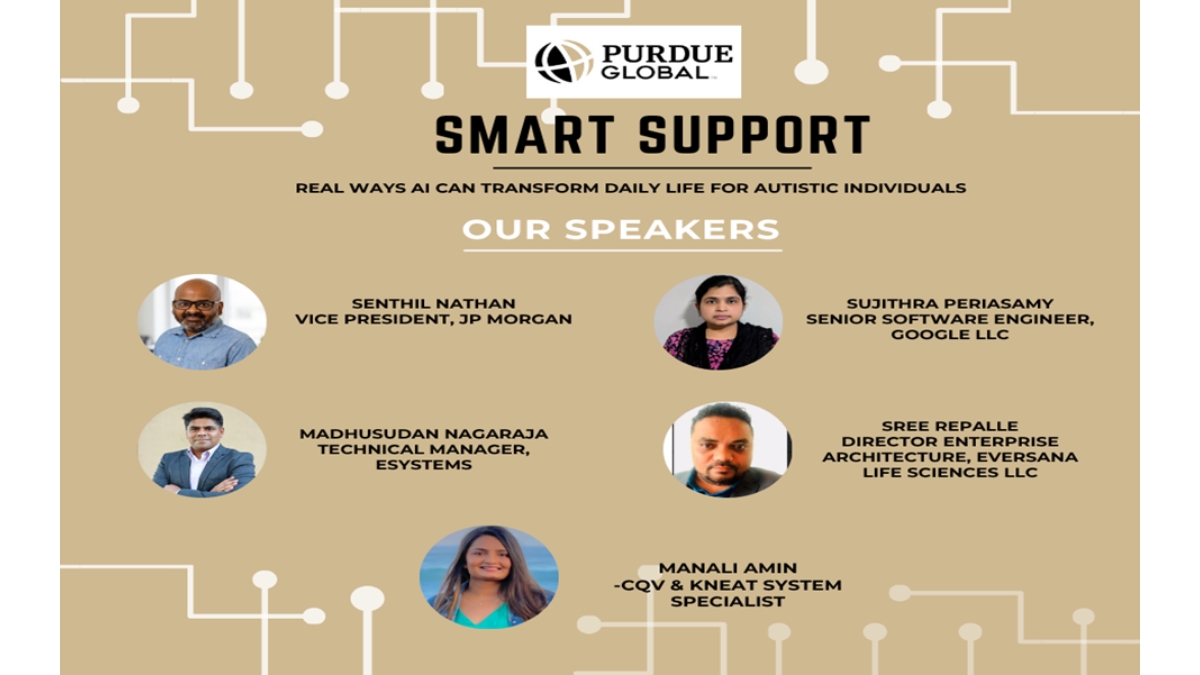
That question was at the center of a recent webinar hosted by Autism Speaks University (ASU) at Purdue Global, organized in collaboration with Ascend Ventures. On November 18, 2025, ABA graduate students, parents, and members of the community working closely with individuals with autism gathered for “Smart Support: Real Ways AI Can Transform Daily Life for Autistic Individuals,” exploring how AI can provide practical, ethical support in everyday life.
The webinar was hosted by Shannon Weiss, ASU Advisor, presenting the mission of ASU and the aim of the event: the use of AI to assist routines, productivity, and the independence of autistic individuals, while supporting ASU’s mission of awareness, education, and positive impact. She pointed out the significance of involving the community and how carefully incorporating technology can lead to real improvements in people’s daily lives.
Shannon then introduced Lestine Grace Saquilabon, President of ASU, who welcomed the audience, presented the five speakers, and highlighted Ascend Ventures’ partnership in bringing together technology, research, and lived experience. Reflecting on her role and the chapter’s purpose, Lestine shared, “As President of Autism Speaks U at Purdue Global, my focus is on bridging the gap between autism awareness and innovation. It’s time the tech and AI industries actively include neurodiverse voices. Our chapter is committed to raising awareness, educating our communities, and building platforms where individuals with autism, their families, caregivers, and therapists are heard and empowered.”
One session drew particular attention: “From Overwhelm to Action: AI as Your Executive Function Bridge for Daily Life,” led by Sujithra Periasamy, Senior Software Engineer at Google. Sujithra is a cloud computing and networking expert working on AI/ML infrastructure and secure distributed systems, with past experience at Cisco on high-performance mobile gateways. Her research focuses on efficient LLM training, cloud-edge orchestration, and ethical AI frameworks. She framed executive function through an engineering lens, comparing the autistic brain to a high-performance computer. It processes enormous amounts of data and can stall under too many tasks, not because it is broken, but because it’s overloaded. In engineering, the solution is offloading routine work to a secondary chip. Sujithra suggested AI could serve the same purpose, handling planning, sequencing, and organization to free the brain for meaningful thinking.
She identified three common barriers to action: initiation, prioritization, and time blindness. Initiation is the gap between knowing and starting. Prioritization is overwhelmed when a task like “clean the room” splits into dozens of micro-tasks. Time blindness makes it hard to judge how long tasks take, turning even simple steps into uncertain ventures. Sujithra underscored that understanding these barriers as structural rather than personal flaws is key to finding effective solutions.
These aren’t flaws, they’re processing bottlenecks. AI can act as an executive function chip to reduce these barriers. First, it can break down complex tasks into small, manageable steps. Second, it can make time visible through backcasting, turning vague schedules into actionable plans. Third, it can serve as an emotional offload, offering neutral support without the social cost of asking others for help. By combining technical tools with human insight, these approaches allow persons with autism to preserve energy and autonomy.
To demonstrate, Sujithra showcased a free, public tool developed for the neurodivergent community named “goblin.tools”. Users type a task, and it automatically breaks it into tiny steps: “email a professor” becomes “open draft, type professor’s name.” Even a research paper starts with “find the assignment rubric.” The strategy of applying small steps or micro-steps mitigates the requirement of activation energy that allows users to create momentum without experiencing stress. She also pointed out some techniques for incorporating these tools into everyday practices, drawing attention to the fact that through routine use, the habits can be transformed over time and the mental load reduced.
Over time, the tool helps internalize a supportive script: I am overwhelmed, I need safety, give me a small next step. Completing each small step makes progress easier and prevents burnout. As Sujithra Periasamy put it, “Pairing AI tools with personal reflection and self-awareness strengthens their impact, creating a feedback loop where technology and human insight reinforce each other.”
The webinar concluded with a Q&A on online safety, data privacy, and consent when using AI. Vasanthan Ramakrishnan, the Founder and Principal Investor at Ascend Ventures, expressed, “AI for autism is not to take over the role of the human caregiver; on the contrary, it will just subtly fill in the gaps of the executive functions, thus allowing the people with autism to use their energy for what is most important.” The speakers were unanimous in saying that AI is a powerful technology; however, its usage must be ethical and deliberate. The attendees discussed the measures to be taken to evaluate tools, draw lines on their use, and make sure that technology comes as an ally, not as a challenge for them.
By the end, the event made clear that this isn’t just about technology. AI, when applied thoughtfully, can bridge overwhelm and action, preserve energy, and protect autonomy. Autism Speaks U, in partnership with Ascend Ventures, presented a vision of AI that is practical, humane, and deeply empowering for the autism community, opening new avenues for everyday support and meaningful independence.

