

Early Geekbench listing of alleged Exynos 2700 SoC reveals deca-core CPU architecture and Xclipse 970 GPU

Samsung last month launched the Exynos 2600 SoC in December 2025, which is expected to power the Galaxy S26 series in some markets. Now, an early Geekbench listing has surfaced for what is believed to be its successor, the Exynos 2700, giving us a first look at some key details.
Alleged Exynos 2700 SoC Early Geekbench listing appears
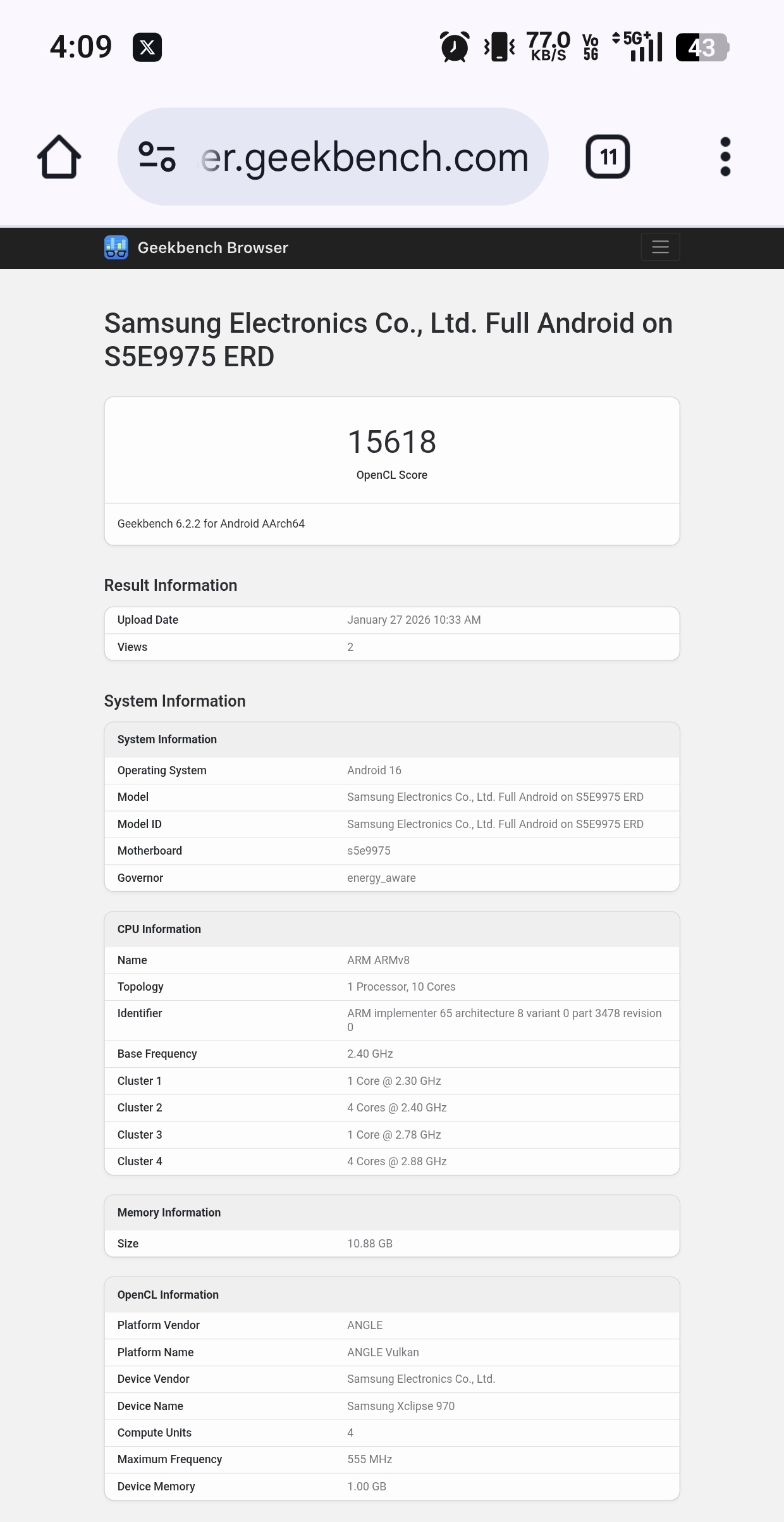
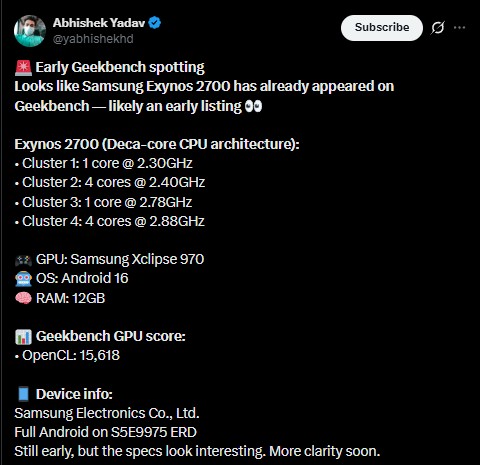
The Geekbench database shows a chipset with a total of four CPU clusters and 10 cores in total. According to the listing, Cluster 1 has one core running at 2.30GHz, Cluster 2 includes four cores clocked at 2.40GHz, Cluster 3 has one core at 2.78GHz, and Cluster 4 consists of four cores running at 2.88GHz. While the listing itself does not explicitly confirm the name Exynos 2700, tipster Abhishek Yadav claims this is an early appearance of the upcoming SoC.
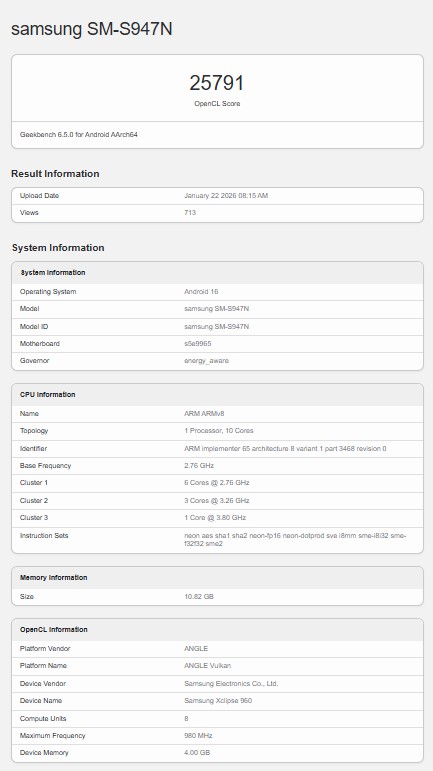
This core layout is also different from the Exynos 2600. That chipset features a triple-cluster setup where Cluster 1 shows six cores at 2.76GHz, Cluster 2 includes three cores at 3.26GHz, and Cluster 3 has one core clocked at 3.8GHz, highlighting that Samsung may be testing a new CPU architecture approach.
Further details in the listing mention a Samsung Xclipse 970 GPU, Android 16, and 12GB of RAM. This is notable because the Exynos 2600 series was paired with the Xclipse 960 GPU, making this appear to be a newer GPU generation, and its performance will be something to watch closely.
Interestingly, the OpenCL information also highlights a clear difference between the two GPU generations. The Samsung Xclipse 970 listing shows just 4 compute units, a maximum frequency of 555MHz, and 1GB of reported device memory. In comparison, the Samsung Xclipse 960 GPU used in the Exynos 2600 was listed with 8 compute units, a higher 980MHz maximum frequency, and 4GB of device memory. This gap helps explain why the early OpenCL score of 15,618 appears significantly lower than the roughly 25,791 score seen on Exynos 2600-powered Galaxy S devices. That said, since this is still an early listing, performance figures may change as development progresses.
It is also worth noting that this benchmark likely comes from an ERD (Engineering Reference Device) board, which manufacturers use internally for early testing and validation. Such hardware often runs with conservative clocks and unfinished drivers, meaning real-world performance on final devices could differ.
Correction in the article:- Correction made in the OpenCL Score – from 24,964 to 25791.
