


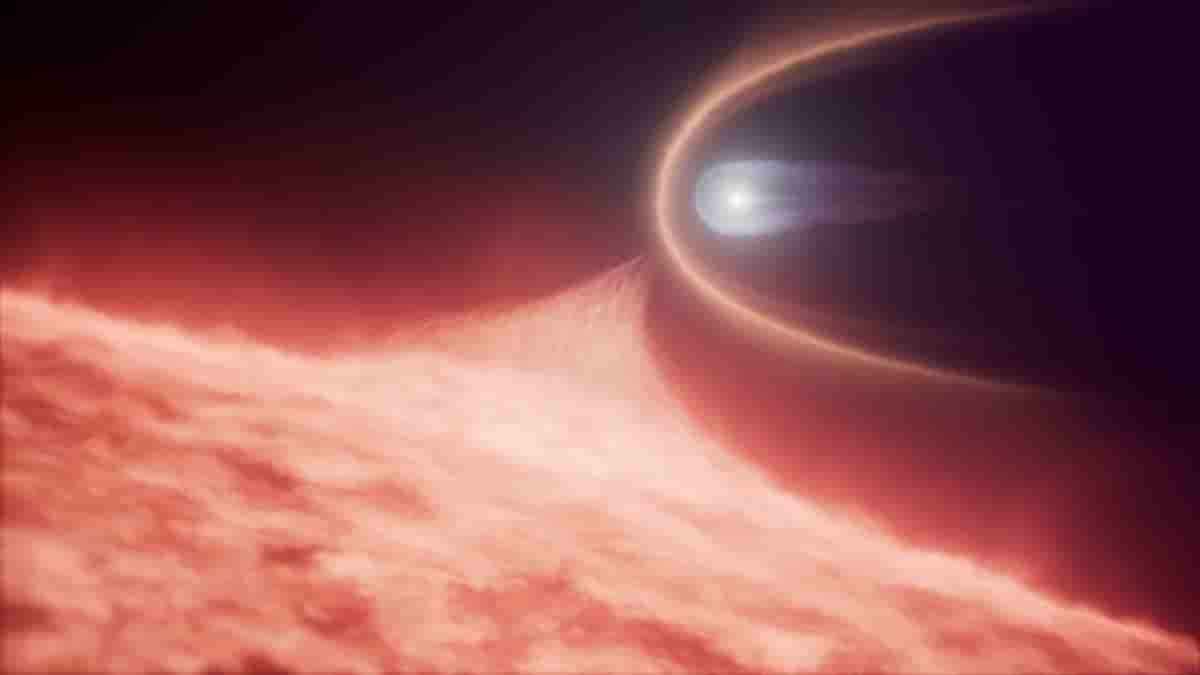
NASA’s Hubble Space Telescope has been operating for more than three decades and continues to make ground-breaking discoveries. NASA’s international team of astronomers discovered a cosmic rarity: an ultra-massive white dwarf star resulting from a white dwarf merging with another star. This discovery was made by the Hubble Space Telescope’s sensitive ultraviolet observations.
Hubble spotted an unusual star 128 light-years away.
With its unique ultraviolet capabilities, Hubble determined this star is a rare ultramassive white dwarf, made up of merged stars: https://t.co/2Hp1LBjUBC
Find out more about this star's intriguing atmosphere in this video ⬇️ pic.twitter.com/k5Bzy1LSE0
— Hubble (@NASAHubble) August 13, 2025
A white dwarf is a dense object with the same diameter as Earth, and represents the end state for stars that are not massive enough to explode as core-collapse supernovae. It is said that our Sun will become a white dwarf in about 5 billion years.
“It’s a discovery that underlines things may be different from what they appear to us at first glance,” said the principal investigator of the Hubble program, Boris Gaensicke, of the University of Warwick in the United Kingdom. “Until now, this appeared as a normal white dwarf, but Hubble’s ultraviolet vision revealed that it had a very different history from what we would have guessed.”
The new discovery marks the first time that a white dwarf born from colliding stars has been identified by its ultraviolet spectrum. Astronomers used Hubble’s Cosmic Origins Spectrograph to investigate a white dwarf called WD 0525+526. It is located 128 light-years away and is 20% more massive than the Sun. With a temperature of almost 21,000 kelvins (37,000 degrees Fahrenheit) and a mass of 1.2 solar masses, WD 0525+526 is hotter and more massive than the other white dwarfs in this group.
In visible light, the spectrum of WD 0525+526’s atmosphere resembled that of a typical white dwarf. However, Hubble’s ultraviolet spectrum revealed something unusual: evidence of carbon in the white dwarf’s atmosphere. The appearance of carbon signals a more violent origin than the typical single-star scenario.
